Holiday Calendar
103 saved#2,174 of 6,224

National Fragrance Day

A cultural observance on March 21 celebrating the artistry, history, and sensory experience of perfumes and fragrances.

Sunday
21
March 2027
YEARLY DATEMarch 21
OBSERVED INUnited States
CATEGORYStyle
SUBCATEGORYMakeup
ORIGIN

Institutional Initiative

FOUNDING ENTITY
The Fragrance Foundation
FIRST OBSERVED
2018
HOW THE HOLIDAY CAME TO BE

The Fragrance Foundation, a nonprofit trade organization founded in New York in 1949, officially established March 21 as Fragrance Day™ in 2018. The initiative aimed to unite the fragrance community, educate consumers, and inaugurate the spring season.

INTRO

Introduction

The word "perfume" comes from the Latin "per fumum," meaning "through smoke," a reference to the aromatic resins ancient civilizations burned in religious rituals thousands of years before bottled fragrances existed. National Fragrance Day on March 21 marks the start of spring and draws attention to an art form that connects chemistry, culture, and personal identity in a single spritz.

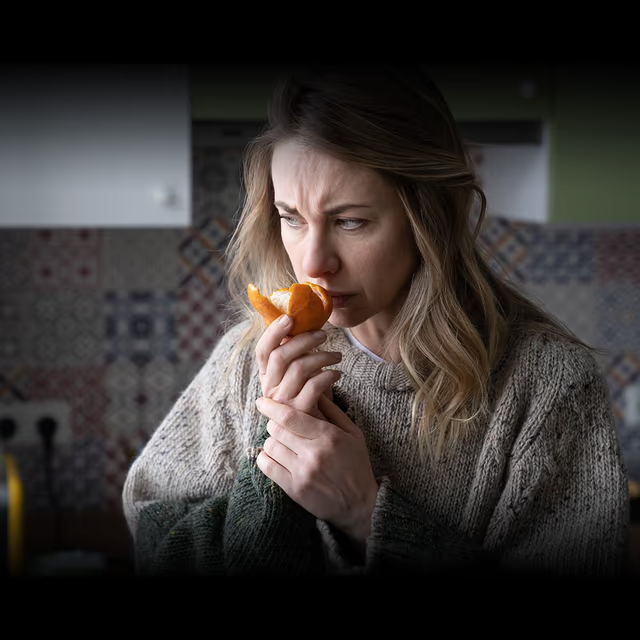
Smell is the only human sense with a direct neural pathway to the brain's emotion and memory centers. That biological wiring explains why a familiar scent can transport someone back decades in an instant, and why the fragrance industry has grown into a global market valued at nearly $59 billion.

Advertisement

DEALS & OFFERS

2026’s deals have wrapped

See who celebrated this year, and browse offers from past years.

ORIGINS

Fragrance Day history

INTRODUCTION

The story behind National Fragrance Day stretches back millennia, to a time when fragrance was not a luxury but a sacred tool. The earliest known reference to a named perfume maker appears on a cuneiform tablet from Mesopotamia dating to around 1200 BCE. The tablet identifies Tapputi, a female chemist who developed techniques for extracting and filtering aromatic compounds from flowers and oils.

Ancient Egyptians used fragrance extensively in religious ceremonies, embalming, and daily life. The Greeks and Romans expanded the practice, incorporating scented oils into bathing rituals and public culture. The word "perfume" itself entered language through the Latin phrase "per fumum," reflecting the earliest method of releasing scent: burning aromatic resins.

CHAPTER 01

The rise of modern perfumery

A major turning point came during the Islamic Golden Age, when the Persian physician Ibn Sina (Avicenna) refined the steam distillation process for extracting essential oils, particularly from roses. His technique, developed around the 10th century, remains a foundation of perfume production today.

In 16th-century France, tanners in the town of Grasse began perfuming leather gloves to mask the odor of their trade. When Catherine de Medici popularized scented gloves at the French court, Grasse gradually shifted from leather production to fragrance cultivation. Its ideal climate for growing jasmine, rose, and lavender helped it become the world's perfume capital, a status UNESCO formally recognized in 2018 by inscribing the region's perfumery skills on its Intangible Cultural Heritage list.

CHAPTER 02

Synthetics and the modern era

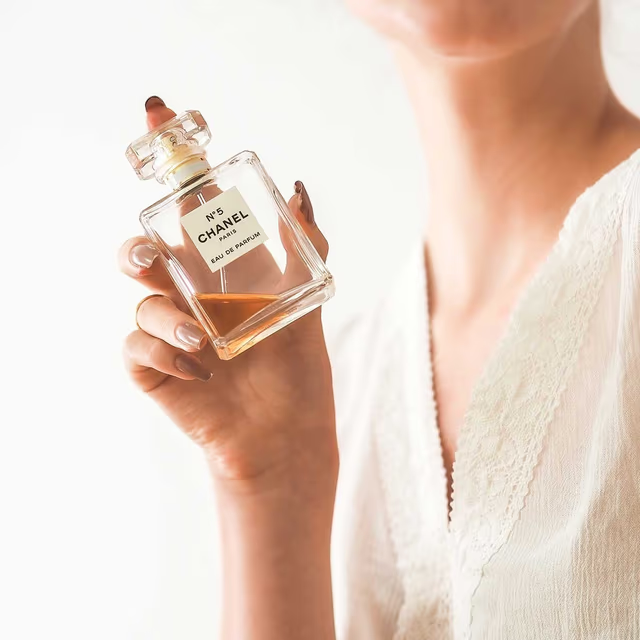
The 19th century introduced synthetic aroma chemicals, which expanded the perfumer's palette beyond natural ingredients. In 1921, perfumer Ernest Beaux leveraged synthetic aldehydes to create Chanel No. 5, one of the first "abstract" fragrances that did not attempt to replicate a single flower. The perfume became a cultural icon and demonstrated that chemistry could produce entirely new olfactory experiences.

CHAPTER 03

An industry unites around a day

The Fragrance Foundation, a nonprofit trade organization co-founded in New York in 1949 by Chanel, Coty, Elizabeth Arden, Guerlain, and Helena Rubinstein, had spent decades advocating for the fragrance category through its annual FiFi Awards and educational programs. Under President Linda G. Levy, who joined in late 2017, the Foundation officially designated March 21 as Fragrance Day in 2018. The inaugural celebration included nationwide retail activations, a commissioned street mural in Brooklyn by artist Marco Santini, and a social media campaign that reached 400 million people. The Foundation has continued to build on the observance each year, expanding it with perfumer panels, scent discovery sessions, and brand partnerships.

TIMELINE

National Fragrance Day Timeline

Earliest recorded perfume maker documented

A cuneiform tablet from Mesopotamia identified Tapputi, a female chemist who developed techniques for extracting scents from flowers and oils.

First alcohol-based perfume created

Hungary Water, an alcohol-based scent made with rosemary, was produced for Queen Elizabeth of Hungary, marking a shift from oil-based formulations.

Chanel No. 5 revolutionizes perfumery

Perfumer Ernest Beaux created Chanel No. 5 using synthetic aldehydes, producing one of the first abstract floral compositions and redefining modern fragrance design.

The Fragrance Foundation established

Chanel, Coty, Elizabeth Arden, Guerlain, and Helena Rubinstein co-founded The Fragrance Foundation in New York to promote consumer education about fragrance.

Fragrance Day officially launched

The Fragrance Foundation designated March 21 as Fragrance Day, inaugurating it with nationwide retail events and a social media campaign that reached 400 million people.

UNESCO recognizes Grasse perfumery skills

UNESCO inscribed the perfume-related skills of Grasse, France, on its Intangible Cultural Heritage list, covering plant cultivation, raw material processing, and scent composition.

GET INVOLVED

How to Celebrate National Fragrance Day

EDITOR'S PICK

Visit a fragrance counter and learn your scent family

Most department store fragrance counters offer free consultations to help identify whether you gravitate toward floral, oriental, woody, or fresh scent families. The Fragrance Foundation's Fragrance Day page lists participating retailers and special events happening near you.

EXPLORE

Explore the science of smell at a museum

The Institute for Art and Olfaction in Los Angeles hosts exhibitions and workshops connecting scent with art and science. If you cannot visit in person, their online resources explain techniques like headspace technology, which captures the scent of living flowers in their natural environment.

TRY

Try blending your own fragrance at home

Start with three essential oils representing a top note (citrus or herb), a middle note (floral or spice), and a base note (sandalwood or vanilla). The Tisserand Institute publishes safety guidelines for working with essential oils, including dilution ratios and skin sensitivity considerations.

READ

Read about the history of a classic perfume

Pick one iconic fragrance and research its creation story. Chanel No. 5's development by Ernest Beaux, Guerlain's Shalimar inspired by the Mughal gardens of Lahore, or Thierry Mugler's Angel, which introduced gourmand notes into mainstream perfumery, each offers a window into a different era of fragrance design.

DOCUMENT

Document your scent memories in a journal

Write down three to five smells that trigger specific memories and describe the scenes they evoke. Harvard neuroscientist Venkatesh Murthy has documented how olfactory signals travel directly to brain regions governing emotion and memory, which is why scent-triggered recall is often more vivid than visual or auditory memory.

WHY THIS DAY MATTERS

Why We Love National Fragrance Day

Perfumery preserves centuries of cultural heritage

UNESCO's 2018 inscription of Grasse's perfumery skills recognized three distinct knowledge areas: the cultivation of perfume plants, the processing of natural raw materials, and the art of fragrance composition. The recognition underscored that traditional perfumery is a living craft requiring intergenerational knowledge transfer, not merely an industrial process.

Fragrance anchors a nearly $59 billion global industry

The global fragrance market was valued at approximately $58.89 billion in 2025, with projections reaching $89.41 billion by 2033. The day highlights an industry that employs chemists, cultivators, designers, and marketers across dozens of countries.

Smell is uniquely wired to memory and emotion

Olfactory signals bypass the brain's thalamus and travel directly to the amygdala and hippocampus, making smell the only sense with a direct neural pathway to emotion and memory centers. This biological architecture explains why a single scent can trigger vivid autobiographical memories decades after the original experience.

Test your knowledge

How well do you know National Fragrance Day?

1 / 8

Which organization officially established Fragrance Day on March 21?

FOR MARKETERS & CREATORS

Turn every day into a moment your audience actually shows up for.

8.4M
Monthly readers
5K+
Holidays tracked