March 21
National Flower Day
An annual observance on March 21, the spring equinox, recognizing the cultural, economic, and ecological significance of flowers.
Unknown
Unknown
The origin of National Flower Day is undocumented. No verifiable founder or establishing organization has been identified. The March 21 date aligns with the spring equinox.
Introduction
The United States imported a record $1.98 billion in cut flowers in 2024. More than 80% came from Colombia alone. American growers produced roughly $350 million worth of cut flowers domestically that same year, a fraction of what arrives by air from South America daily.
That imbalance was not always the case. The American cut flower industry was born in California in the late 1870s, built by immigrant families who grew and sold flowers in communities from San Francisco to Los Angeles. What was once a local, domestic industry has become one of the most globally dependent supply chains in American commerce. National Flower Day, observed on the spring equinox, arrives at a moment when the industry is navigating new tariffs, a pollinator crisis, and a growing consumer movement to buy local.
National Flower Day History
Humans have cultivated flowers for at least 5,000 years. Ancient Egyptians used lotus blossoms in religious ceremonies. Greeks wove flowers into mythology, associating roses with Aphrodite and narcissus with the underworld. But the most elaborate system of flower communication developed much later, in 19th-century Europe.
In 1819, Charlotte de Latour published Le Langage des Fleurs in Paris, the first dictionary devoted entirely to flower symbolism. The book formalized floriography, the coded language of flowers, and was translated across Europe. During the Victorian era, when social norms restricted direct emotional expression, people exchanged "tussie-mussies": small handheld bouquets where each flower carried a specific meaning. A yellow rose communicated jealousy. A red tulip declared love. Lavender expressed devotion. These bouquets served a practical purpose too, their strong scents masking the odors of an era before modern sanitation.
The American flower industry
The commercial cut flower industry in the United States began in California in the late 1870s, pioneered by Theodosia Shepard, a Ventura housewife who began selling garden flowers commercially. California's Mediterranean climate allowed year-round production, and immigrant families — Chinese, Japanese, Italian, and Dutch — expanded and transformed the industry over the following decades.In 1912, fifty-four Japanese immigrant growers founded the Los Angeles Southern California Flower Market, one of the largest in the country. For most of the 20th century, American flowers were grown domestically, with farms concentrated near major cities in the East and in California's coastal valleys.
That changed on October 18, 1965, when the first shipment of Colombian cut flowers arrived in Miami. Colombia's high-altitude equatorial climate produced ideal growing conditions with abundant light and mild temperatures, while labor costs were dramatically lower than in the US. The Andean Trade Preference Act later eliminated tariffs on Colombian flower imports, accelerating the shift. By the 1980s, Colombia was the leading supplier of cut flowers to the United States, and many domestic growers had shut down or shifted to potted plants and specialty varieties.
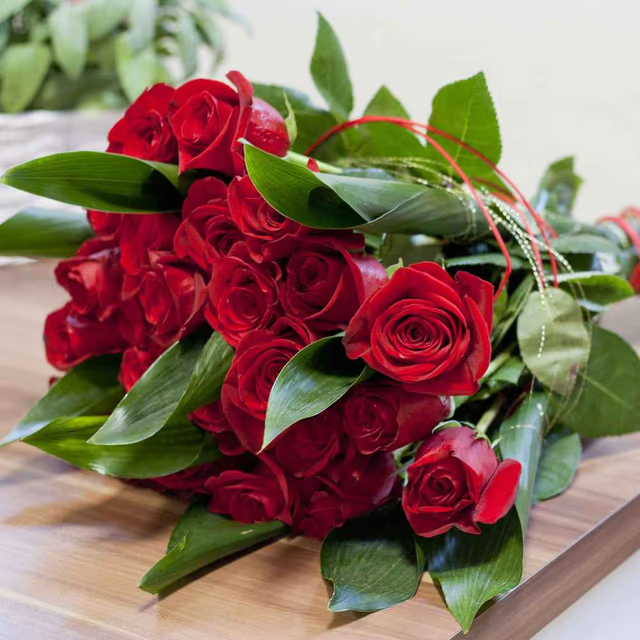
By 2024, the United States imported a record $1.98 billion in cut flowers. Colombia supplied over 80% of imports at $1.59 billion, followed by Ecuador at $693 million. American growers produced only about $350 million domestically. California still leads domestic production at 60% of US cut flower sales, but many of its growers now focus on specialty varieties too delicate for long-distance transport.
In 2025, new tariffs were placed on Colombian imports (from 0% to 10%) and Ecuadorian imports (from 6.8% to 15%), creating uncertainty in an industry operating on thin margins.
The national flower
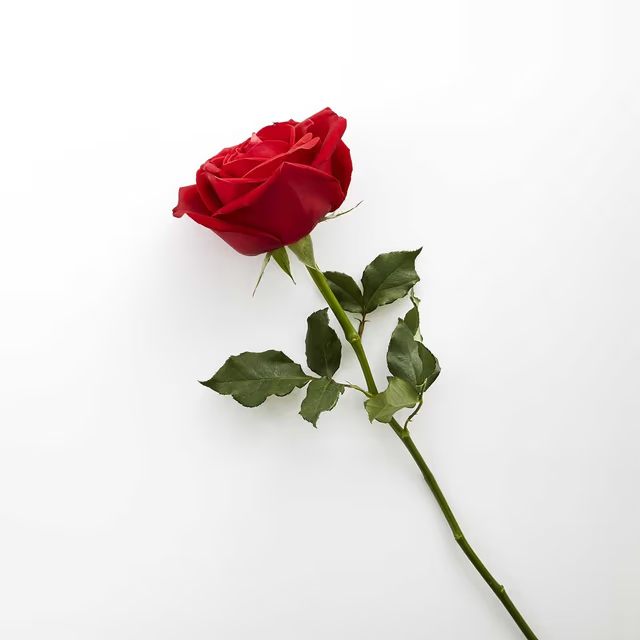
On November 20, 1986, President Ronald Reagan signed Proclamation 5574 in the White House Rose Garden, designating the rose as the national floral emblem of the United States. The proclamation noted that George Washington had been an active rose breeder at Mount Vernon and that roses were grown in all fifty states. The decision followed decades of competing proposals, including a sustained campaign by Senator Everett Dirksen to designate the marigold.The observance
National Flower Day has no documented founder or establishing organization. The March 21 date aligns with the spring equinox, when the Northern Hemisphere's growing season begins.National Flower Day Timeline
Charlotte de Latour publishes the first flower language dictionary
Theodosia Shepard pioneers commercial flower sales in California
Japanese immigrants found the LA Flower Market
First Colombian cut flowers arrive in Miami
The rose is declared the national flower
How to Celebrate National Flower Day
- 1
Buy from a local flower farm
The Slow Flowers directory connects consumers with domestic flower growers and florists who source locally. Local flowers are fresher, last longer, and support American growers in a market dominated by imports.
- 2
Plant something that blooms in your zone
Look up your USDA Plant Hardiness Zone and choose a flower rated for your region. Planting on or near the equinox gives spring-blooming varieties the full growing season ahead.
- 3
Learn the Victorian language of flowers
Floriography assigned specific meanings to hundreds of flower species. Red roses meant love, yellow roses meant jealousy, lavender expressed devotion. Send someone a flower with a specific meaning and include a note explaining what it represents.
- 4
Support pollinators in your yard
Plant native wildflowers that support bees, butterflies, and other pollinators. Avoid pesticides, especially neonicotinoids. Even a small patch of native flowers on a balcony or in a garden bed contributes to pollinator habitat in your area.
- 5
Press a flower and preserve it
Place a fresh flower between two sheets of parchment paper inside a heavy book and wait two to three weeks. Pressed flowers can be framed, added to journals, or used in homemade cards. It is one of the simplest ways to make a flower last beyond its natural life.
Why We Love National Flower Day
- A
The US flower market is almost entirely import-dependent
The United States imported a record $1.98 billion in cut flowers in 2024, with Colombia alone supplying over 80%. American growers produced only about $350 million domestically. New tariffs on Colombian and Ecuadorian imports in 2025 are creating uncertainty in an industry already operating on thin margins.
- B
The pollinator crisis threatens both flowers and food
Commercial beekeepers in the US have reported annual hive losses averaging 29 to 45 percent since 2006, driven by parasites, pesticides, habitat loss, and climate change. Nearly 75% of major food crops depend on pollinators. The same bees that sustain flower production sustain agriculture.
- C
A growing movement is pushing consumers to buy local flowers
The Slow Flowers movement encourages consumers to buy domestically grown, seasonal flowers instead of imports. Local flowers are fresher, have a lower carbon footprint from transportation, and support the roughly 10,000 domestic floriculture operations still operating across the country.
Holiday Dates
| Year | Date | Day |
|---|---|---|
| 2023 | Tuesday | |
| 2024 | Thursday | |
| 2025 | Friday | |
| 2026 | Saturday | |
| 2027 | Sunday |