Holiday Calendar

National Hot Chocolate Day

Next celebratedSunday, January 31, 2027

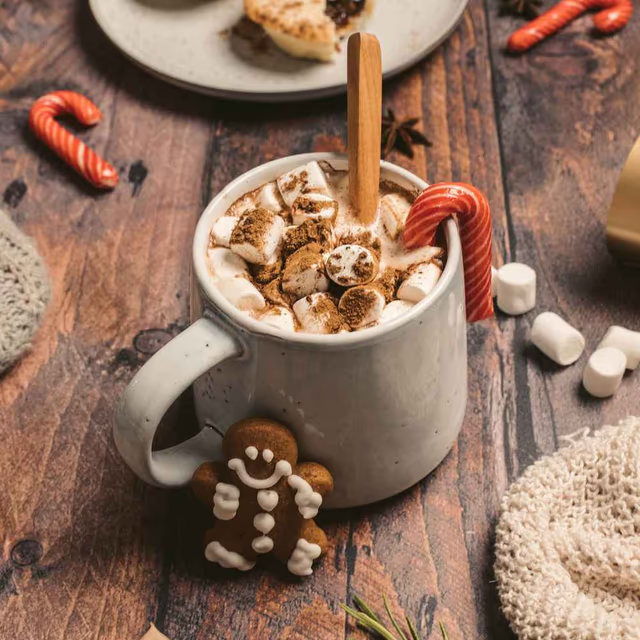
Hot chocolate belongs to the coldest stretch of the year, and National Hot Chocolate Day is the excuse to make a proper one. Warm the milk, stir it slowly, and drink it in the warmest chair in the house.

Countdown to the day
--DAYS
--HRS
--MIN
--SEC
Have an update or spot an error?
YEARLY DATEJanuary 31
OBSERVED INUnited States
CATEGORYFood
SUBCATEGORYChocolate
ORIGIN

Community Origin

FOUNDING ENTITY
Not documented
FIRST OBSERVED
Not documented
HOW THE HOLIDAY CAME TO BE

The record begins on a listing page, not a proclamation.

One holiday registry's archived January 31 pages do not carry National Hot Chocolate Day in 2013, 2014 or 2015 and do carry it in 2016, which dates the listing rather than the day. No founder or establishing record has been located: searches of the Federal Register and of HathiTrust's full-text index return nothing under the name.

+ Know the story? Submit a founder Help us complete this holiday
INTRO

Poured from cup to cup until it foamed

The chocolate bar is a leftover from a cup. Cornell University Library's exhibition on chocolate dates the modern industry to an 1828 press whose product was an easily prepared powdered hot chocolate, and the cocoa butter that press took out is what makes a bar supple enough to mould. National Hot Chocolate Day belongs to the thing that came first.

For most of its history chocolate was something you drank, and for a long stretch of that history it was not a drink anyone would recognise today. Even the pots it was served in are the wrong shape for the cup people picture.

What belongs in the cup turns out to be a legal question as much as a domestic one. Three jurisdictions have written answers into law, and each of them drew the line somewhere different.

Advertisement

DEALS & OFFERS

2026’s deals have wrapped

See who celebrated this year, and browse offers from past years.

ORIGINS

Hot Chocolate Day history

INTRODUCTION

Puerto Escondido, in what is now Honduras, has produced the residue of a cacao beverage inside a spouted bottle from the Ocotillo phase. Radiocarbon dates from the layers beneath it put the bottle after 1150 B.C.

It was probably not chocolate. The team that analysed the residues argued for something else: a drink likely made by fermenting the sweet fruit pulp around the seeds rather than the seeds themselves. The bottle agrees with them, because that shape is adapted for pouring liquids and is no use for raising a froth.

Frothing became a standard step in the Mesoamerican preparation. When a spouted bottle with a flaring neck turns up in the Middle Formative, the same researchers read the new shape as a possible sign that somebody had begun whipping air into the cup.

CHAPTER 01

Europe met it as medicine

Cornell University Library's chocolate exhibition records that Spaniards introduced the drinking of chocolate to Europe, where, in the medical system of the time, those who could afford it used chocolate as a tonic and remedy. Comfort came later than the prescription did.

CHAPTER 02

The press that made the powder

Cornell's exhibition puts untreated cocoa mass, the paste left after grinding the beans, at about 53 percent cocoa butter. In 1828 Van Houten patented his method for taking most of that out, a hydraulic press that brought the figure down to about 27 percent. What was left was a cake dry enough to be milled into the powder now sold as cocoa.

CHAPTER 03

How the drink got into a packet

The American version arrived out of a warehouse. Charles Sanna's family firm, Sanna Dairy Engineers, had been supplying American troops with packets of powdered creamer during the Korean War, and overproduced to be sure of meeting its contract.

Sanna worked the surplus into a cocoa mix at his own stove in Menomonie, Wisconsin, using powdered creamer, cocoa, sugar, vanilla and hot water. His brother called it Brown Swiss. Renamed and relaunched in 1961, Smithsonian Magazine reports, it became the first instant cocoa that could be made with hot water instead of milk.

The observance is the one part of this story with no record behind it. What it carries instead is the oldest thing in the cupboard.

TIMELINE

Timeline

A spouted bottle in Honduras

Residue in a bottle from Puerto Escondido carries theobromine, the marker that identifies a cacao drink.

Van Houten patents the press

A hydraulic press strips most of the cocoa butter out of cacao and leaves a powder that mixes into a cup.

Swiss Miss reaches groceries

The mix relaunches as the first instant cocoa that could be made with hot water instead of milk.

Cocoa crosses Antarctica

Will Steger packs enough Swiss Miss for more than 2,000 cups on a dog-sled journey across the continent.

Europe defines the cup

Directive 2000/36/EC gives legal definitions to drinking chocolate and to the starch-thickened chocolate a la taza.

The day surfaces on a calendar

The earliest archived holiday-listing page found carrying the day was captured this year, which dates the listing rather than the day.

WHY THIS DAY MATTERS

Why We Love National Hot Chocolate Day

ANTIQUITY

The plant was in use 5,300 years ago

Cacao starch grains, absorbed theobromine residues and ancient DNA at the Santa Ana-La Florida site in southeast Ecuador date from approximately 5,300 years ago. That finding puts the oldest known centre of cacao domestication in the upper Amazon rather than in Mesoamerica.

HOUSEHOLD

A sachet put the drink in the cupboard

Charles Sanna's mix is credited with launching America's instant hot chocolate industry. It worked with hot water rather than milk, which is why a cup of it asks for nothing but a kettle.

GOOD TO KNOW

Surprising facts about National Hot Chocolate Day

A Maya cup is painted with its own use

The Princeton Vase, a Late Classic drinking cup dated 670 to 750 in the Princeton University Art Museum, shows a woman pouring a stream of liquid chocolate from one vessel into another. The museum notes that chocolate was frothed for drinking in a vessel like this one, as specified by one of the hieroglyphic texts on the vase itself.

Chemists looked for honey and chile and found neither

Gas chromatography on four Chotepe-phase samples from Puerto Escondido turned up no beeswax marker compounds for honey and no capsaicin for chile, two of the additives later chocolate drinks carried. Their absence is part of why the early drink is read as a pulp beverage rather than a seed one.

Dutching is a chemical fix with a nickname

Cocoa powder does not readily mix with liquid, so Van Houten treated it with alkaline salts to improve it. The treatment came to be known as Dutching.

The mix was named after the wrong cow

Charles Sanna's brother named the powdered cocoa Brown Swiss, after a breed of dairy cow. The milk in the product actually came from Holsteins, which give milk with less butterfat.

Airlines dropped it because customers pocketed it

Brown Swiss sold largely to airlines and restaurants, and then it stopped. They quit buying the cocoa packets after noticing that customers were swiping them.

GOOD TO KNOW

National Hot Chocolate Day Around the World

United States

Federal law grades the powder by how much fat was pressed out of it: breakfast cocoa at not less than 22 percent cacao fat, cocoa between 10 and 22 percent, lowfat cocoa under 10 percent. Part 163 sets fifteen standardized cacao products, and none of them describes a drink.

European Union

EU law reserves drinking chocolate for a mixture of cocoa powder and sugars containing not less than 25 percent cocoa powder, and chocolate a la taza for a chocolate made with flour or starch from wheat, rice or maize, capped at 8 percent. A family grade allows up to 18 percent, and the reserved names must be used in trade.

Mexico

The Mexican standard NOM-186-SSA1/SCFI-2013 defines chocolate para mesa as a product made from cacao paste and unrefined sugar, and it requires that sugar to have a particle size greater than 70 microns. The grade is written around its grain.

GET INVOLVED

How to Celebrate National Hot Chocolate Day

EDITOR'S PICK

Make a cup from chopped chocolate

Skip the sachet and melt real chocolate into hot milk over a low heat. It is the older of the two drinks and it behaves differently in the mug.

RAISE

Raise a head of foam the old way

Pour the finished drink from one jug down into another, two or three times, until it carries a proper head. Raising a froth this way is a standard step in the Mesoamerican preparation.

TASTE

Taste a cocoa and a drinking chocolate together

Make one cup from cocoa powder and one from melted chocolate, and drink them side by side. The difference the law spends so many words on is obvious in about a second.

READ

Read the tin before you buy it

Turn the pack over and read the ingredients before you buy. Cocoa powder and chocolate are different starting points, and the list tells you which cup you are about to make.

FILL

Fill a flask and take it outside

January is the point of a hot drink, so carry one somewhere cold rather than drinking it at the counter. A vacuum flask holds the heat long enough to make the walk worth it.

Test your knowledge

How well do you know National Hot Chocolate Day?

1 / 9

What minimum cacao fat does US law require in breakfast cocoa?

Answer

No. It is an unofficial observance with no legal standing found in the indexes checked, so January 31 is a normal working day.

COLOPHON

Sources

How we know what’s on this page. References, not endorsements.

9sources
6primary records
5independently dated
Primary records
Proceedings of the National Academy of Sciences2007-11-27
Chemical and archaeological evidence for the earliest cacao beverages
Reports theobromine residues in pottery from Puerto Escondido in Honduras, including a spouted bottle radiocarbon-dated after 1150 B.C., and argues the earliest cacao drinks there were fermented from the fruit pulp rather than the seeds.
View source
Princeton University Art Museum
Uk'ib (drinking cup) depicting a mythological scene
The museum's catalogue record for the Princeton Vase, a Late Classic Maya chocolate-drinking cup dated 670 to 750, painted with a woman pouring chocolate from one vessel into another to raise its foam.
View source
Electronic Code of Federal Regulations
21 CFR Part 163, Cacao Products
The FDA's fifteen standardized cacao products, including the cacao-fat thresholds separating breakfast cocoa, cocoa and lowfat cocoa, and containing no standard for a beverage.
View source
EUR-Lex2024-06-24
Directive 2000/36/EC relating to cocoa and chocolate products intended for human consumption
The consolidated European directive reserving sales names for cocoa powder, drinking chocolate, chocolate a la taza and chocolate familiar a la taza, with their compositional minimums, and making those names compulsory in trade.
View source
Diario Oficial de la Federacion2014-02-17
NORMA Oficial Mexicana NOM-186-SSA1/SCFI-2013, Cacao, chocolate y productos similares, y derivados del cacao
Mexico's official standard for cacao and chocolate products, defining chocolate para mesa as a product of cacao paste and unrefined sugar with a particle size greater than 70 microns.
View source
Nature Ecology and Evolution2018
The use and domestication of Theobroma cacao during the mid-Holocene in the upper Amazon
Reports cacao starch grains, theobromine residues and ancient DNA at the Santa Ana-La Florida site in southeast Ecuador dating from about 5,300 years ago, and places the oldest known centre of cacao domestication in the upper Amazon.
View source
Additional coverage
FOR MARKETERS & CREATORS

Turn every day into a moment your audience actually shows up for.

8.4M
Monthly readers
5K+
Holidays tracked