
Holiday Calendar

Black History Month

Next celebratedMonday, February 1, 2027

A nationwide observance throughout February recognizing the history, achievements, and culture of African Americans across U.S. life.

Countdown to the day
--DAYS
--HRS
--MIN
--SEC
Last updated February 26, 2026 · by the Holiday Calendar TeamHave an update or spot an error?
YEARLY DATEAll of February
OBSERVED INUnited States
CATEGORYCulture
SUBCATEGORYBlack History
ORIGIN

Institutional Initiative

FOUNDING ENTITY
Dr. Carter G. Woodson and the Association for the Study of Negro Life and History (ASNLH)
FIRST OBSERVED
1926
Woodson and the ASNLH launched Negro History Week in February 1926, timed to the Lincoln and Douglass birthdays.
HOW THE HOLIDAY CAME TO BE

A week timed to two February birthdays.

In February 1926, historian Dr. Carter G. Woodson and the Association for the Study of Negro Life and History launched the first Negro History Week, scheduling it for the second week of February to align with the birthdays of Abraham Lincoln and Frederick Douglass. In 1976, the observance was expanded to a full month, and President Gerald R. Ford issued the first presidential message recognizing Black History Month.

Read ASALH origin accountvia Association for the Study of African American Life and History
INTRO

The month that began as a single week

Black History Month did not start as a month. It started as a week. In February 1926, the historian Carter G. Woodson introduced Negro History Week, and it stayed a week for the next fifty years.

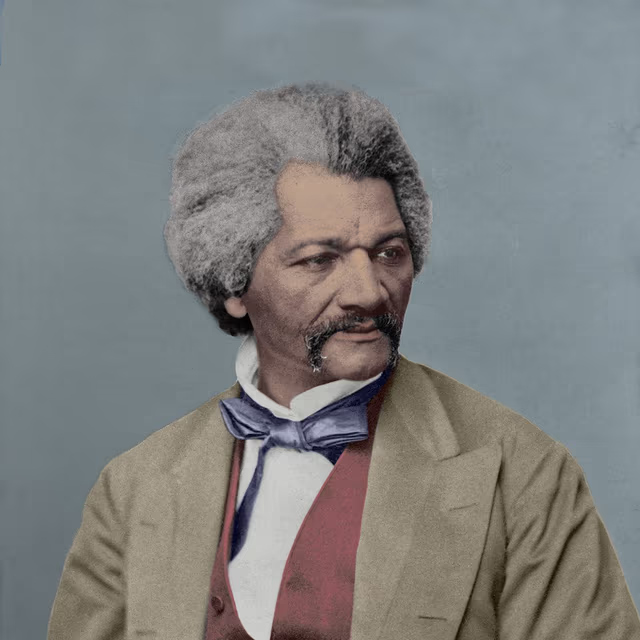
The choice of February was no accident, and it had nothing to do with the calendar's shortest month. Woodson set the observance in the second week of February because that week already held two birthdays Black communities had marked for years: Abraham Lincoln's on February 12 and Frederick Douglass's on the 14th.

He was not inventing a tradition. He was extending one. As the founding institution puts it, Woodson asked the public "to extend their study of black history, not to create a new tradition." The expansion to a full month came in 1976, the year of the nation's Bicentennial.

Advertisement
ORIGINS

Black History Month history

INTRODUCTION

Woodson was born in New Canton, Virginia, in 1875, and he grew into one of the most credentialed historians of his generation. Most of his life's work pointed toward a single goal: getting Black history studied seriously and studied widely.

CHAPTER 01

An association born at a Chicago YMCA

On September 9, 1915, Woodson and four others founded the Association for the Study of Negro Life and History at the Wabash YMCA in Chicago. The spark was a celebration Woodson had attended marking the 50th anniversary of emancipation.

A year later, in 1916, he started a scholarly journal devoted to the subject, now known as the Journal of African American History. It was among the earliest of its kind, and it gave the new field a permanent home in print.

CHAPTER 02

One week in February 1926

In February 1926, Woodson and his association launched the first Negro History Week. He placed it in the second week of the month on purpose.

That week already carried two birthdays Black communities celebrated: Lincoln's and Douglass's. Woodson's aim was modest and deliberate. He wanted the public to extend study already underway, and he himself never confined the subject to a single week.

CHAPTER 03

From a week to a month, and into law

The week held its shape for half a century. In 1976, during the U.S. Bicentennial, the observance expanded to a full month, and President Gerald R. Ford became the first president to issue a message recognizing Black History Month.

Federal recognition followed in 1986, when Congress passed Public Law 99-244 designating February as National Black (Afro-American) History Month. Since 1996, presidents have issued an annual proclamation, each endorsing the theme that Woodson's association still sets every year. ]]>

ORIGINS

Black History Month history

AT A GLANCE

Carter G. Woodson and ASALH at a glance

Founder
Dr. Carter G. Woodson, historian, born 1875
Known as
The Father of Black History
Institution
Association for the Study of African American Life and History (ASALH)
Institution founded
September 9, 1915, in Chicago
First observance
1926, as Negro History Week
Current role
Sets the official annual theme
ORIGINS

Black History Month history

TIMELINE

Timeline

An association is founded

Carter G. Woodson and four others found the ASNLH in Chicago on September 9.

First Negro History Week

Woodson and the ASNLH launch the first Negro History Week, set in the second week of February.

Expanded to a month

The observance becomes a full month, and President Ford issues the first presidential message on February 10.

Federal law designates February

Congress passes Public Law 99-244 naming February National Black (Afro-American) History Month.

Annual proclamations begin

Presidents start issuing an annual proclamation for the observance each February.

The centennial year

The observance reaches its 100th year, with the ASALH theme "A Century of Black History Commemorations."
ORIGINS

Black History Month history

to seize the opportunity to honor the too-often neglected accomplishments of black Americans in every area of endeavor throughout our history
Gerald R. FordPresident of the United States, 1976 message
ORIGINS

Black History Month history

ORIGINS

Black History Month history

Answer

Black History Month is observed throughout the entire month of February in the United States.

FOR MARKETERS & CREATORS

Turn every day into a moment your audience actually shows up for.

8.4M
Monthly readers
5K+
Holidays tracked