
Holiday Calendar

National Dark Chocolate Day

Next celebratedMonday, February 1, 2027

A food observance on February 1 celebrating dark chocolate, the high-cocoa style of chocolate prized for its flavor and its cocoa-bean flavanols.

Countdown to the day
--DAYS
--HRS
--MIN
--SEC
Last updated February 11, 2026 · by the Holiday Calendar TeamHave an update or spot an error?
YEARLY DATEFebruary 1
OBSERVED INUnited States
CATEGORYFood
SUBCATEGORYChocolate
ORIGIN

Community Origin

FOUNDING ENTITY
Not documented
FIRST OBSERVED
Not documented
HOW THE HOLIDAY CAME TO BE

A food day with no documented author.

No founder, proclamation, or establishing organization has been identified for National Dark Chocolate Day. It circulates as one of many food-appreciation days fixed to February 1, with no traceable origin in any primary or authoritative source.

+ Know the story? Submit a founder Help us complete this holiday
INTRO

The word the U.S. government never bothered to define

Reach for a bar labeled "dark," and you might assume some rule guarantees what is inside it. There is none. The U.S. Food and Drug Administration writes legal standards of identity for sweet chocolate, for semisweet and bittersweet chocolate, and for milk chocolate, but "dark chocolate" is not on the list. The phrase is a marketing choice, not a regulated promise.

That gap is the strange heart of National Dark Chocolate Day. The day fixes February 1 to a product that, legally speaking, the country never named. A bar's cacao percentage on the front of the wrapper is a number the brand chose to print, not a floor any agency enforces.

So the celebration sits on a quiet contradiction. Dark chocolate is one of the most studied foods in nutrition science and one of the least defined in food law, and the day is a good excuse to learn what the cacao percentage really tells you, and what the research does and does not show.

Advertisement
ORIGINS

Dark Chocolate Day history

INTRODUCTION

Dark chocolate has no single legal definition, but the rules around it are surprisingly precise. To understand what separates a "dark" bar from a milk bar, you have to start not with cocoa percentages but with a paste called chocolate liquor.

The federal rulebook for chocolate lives in Title 21 of the Code of Federal Regulations, where each kind of chocolate gets its own standard of identity. These standards decide which products may legally carry the word "chocolate" at all.

CHAPTER 01

The paste that makes chocolate "chocolate"

Chocolate liquor is the ground paste of roasted cacao nibs, and it is the base of every real chocolate. Under 21 CFR 163.111, chocolate liquor must contain between 50 and 60 percent cacao fat, the cocoa butter that gives chocolate its melt.

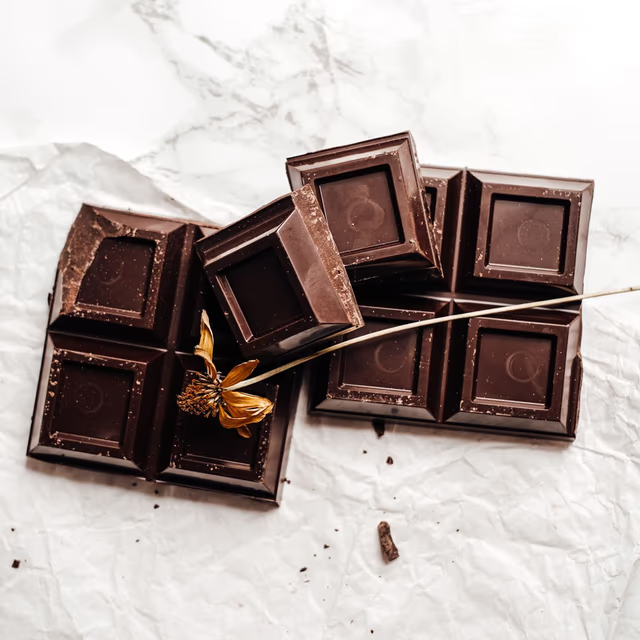
This is the ingredient dark chocolate has more of. Milk chocolate dilutes it with milk and sugar; darker chocolate leans on it. The cacao percentage on a wrapper is, roughly, how much of the bar comes from this paste plus added cocoa butter.
CHAPTER 02

What the FDA actually defines

The standards set hard floors. Sweet chocolate must contain at least 15 percent chocolate liquor by weight under 21 CFR 163.123, and that same rule sets semisweet and bittersweet chocolate at no less than 35 percent. These are the closest regulated cousins to what shoppers call dark.

Milk chocolate, by contrast, must contain at least 10 percent chocolate liquor and at least 12 percent total milk solids under 21 CFR 163.130. Sweet chocolate, in the same family of rules, must stay under 12 percent milk solids. That milk line, not a cocoa percentage, is the legal hinge that separates milk from dark.

CHAPTER 03

A word the law forgot

The framework that governs all of this took shape in a 1988 FDA compliance policy on labeling products as "chocolate". A product may use the word only if it meets one of the cacao-product standards. Yet none of those standards is "dark chocolate," so the term most shoppers reach for has no floor of its own.

The day built around that product carries the same gap. No founder, proclamation, or organization is documented for National Dark Chocolate Day; it surfaces on calendars at February 1 with no traceable origin. The honest record is that the celebration is well attested and its beginnings are not, which leaves the bar itself as the real story.

WHY THIS DAY MATTERS

Why We Love National Dark Chocolate Day

LABELING

"Dark" is a marketing word, not a regulated guarantee.

Because the FDA sets no floor for "dark chocolate," a bar marked dark is not guaranteed to hold more cocoa solids than a milk bar. The cacao percentage and ingredient list, not the word on the front, are the only reliable checks a shopper has.

SCIENCE

A test case for cautious nutrition claims

Dark chocolate is among the most-studied foods for heart health, yet the largest trial of cocoa flavanols did not significantly cut total cardiovascular events. The day is a useful reminder to read what research actually found before treating a food as medicine.

DEFINITION

The milk line is the real divide

What legally separates milk chocolate from sweet or dark chocolate is the 12 percent total-milk-solids threshold, not a cocoa number. That distinction explains why the same bar can be cocoa-rich and still be milk chocolate by law.

AT A GLANCE

Dark chocolate at a glance

What it is
High-cocoa chocolate, little or no milk solids
Cocoa solids
Roughly 50 to 90 percent (Harvard)
For most flavanols
70 percent cacao or higher (Harvard)
Calories
About 150 to 170 per ounce (Harvard)
Per ounce (70 to 85%)
About 12 g fat, 6.8 g sugar (Cleveland Clinic)
FDA "dark" standard
None; closest is semisweet/bittersweet at 35 percent liquor

BY THE NUMBERS

National Dark Chocolate Day by the Numbers

15%
Sweet chocolate minimum cocoa liquor
35%
Semisweet/bittersweet minimum liquor
50-60%
Cocoa butter in chocolate liquor
~2 mmHg
Cocoa short-term blood-pressure effect
27%
COSMOS cardiac-death drop (secondary, unproven)

GOOD TO KNOW

Surprising facts about National Dark Chocolate Day

The largest cocoa trial ran for years and still left the question open

To test cocoa flavanols, COSMOS enrolled 21,442 U.S. adults on a 500 mg daily supplement and tracked them for a median 3.6 years, the biggest and longest trial of its kind. Even at that scale, its authors report it did not significantly reduce total cardiovascular events.

Harvard's leading theory runs through nitric oxide

One reason researchers study cocoa flavanols at all: Harvard's Nutrition Source notes they may prompt the body to make more nitric oxide, a molecule that relaxes blood vessels. It is a proposed mechanism, not a proven payoff.

A major clinic stops short of telling you to eat it

Even while listing possible benefits, the Cleveland Clinic says the evidence is "not compelling enough that we would say you should definitely include this in your diet," a notably cautious verdict from a health institution on a beloved treat.

Dark chocolate is the least-processed chocolate, not the harshest

Despite its bitter edge, dark chocolate is the least-processed kind, the Cleveland Clinic notes, which is why it carries the highest share of the actual cocoa bean and its flavonoids of any chocolate.

That cocoa-bean share is what sets dark apart from milk

Because dark chocolate holds the most cocoa solids, it can carry up to two to three times more flavanol-rich cocoa than a milk bar, per Harvard's Nutrition Source, a difference of composition rather than a promised health effect.

MYTH VS FACT

Common Misconceptions

The myth

Dark chocolate is a proven health food that lowers blood pressure and protects the heart.

The truth

The evidence is cautious, not settled. The COSMOS trial did not significantly reduce total cardiovascular events, and a 2017 Cochrane review found cocoa lowered blood pressure by only about 2 mmHg short-term, with industry-funded studies reporting larger effects.

The myth

"Dark chocolate" is an official FDA category with a guaranteed high cocoa content.

The truth

The FDA defines sweet, semisweet, bittersweet, and milk chocolate, but not "dark chocolate," so a bar's cacao percentage is set by the brand, not by any federal floor.

GET INVOLVED

How to Celebrate National Dark Chocolate Day

EDITOR'S PICK

Read the cacao percentage first

Because no FDA rule guarantees a dark bar's cocoa content, the front-of-pack percentage and the ingredient list are your only real check. Harvard's Nutrition Source suggests 70 percent cacao or higher for the most flavanols.

RUN

Run a tasting flight by percentage

Line up squares at 50, 70, and 85 percent and taste them in order. The climb in bitterness and the drop in sweetness make the cocoa-solids difference something you can taste, not just read.

COMPARE

Compare a dark bar against a milk bar

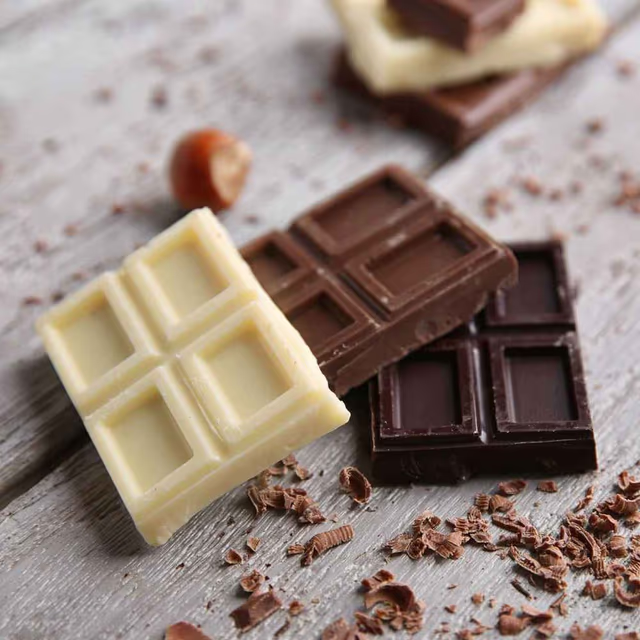
Set a dark square beside a milk one and notice the milk one's softer, sweeter finish. By federal rule the milk bar carries at least 12 percent milk solids, the legal feature that makes it milk chocolate rather than dark.

KEEP

Keep the portion small

Dark chocolate runs about 150 to 170 calories an ounce with a fair amount of saturated fat, so a square or two is the spirit of the day. Treat it as a pleasure to savor, not a supplement to dose.

SHARE

Share the no-definition fact

Tell a friend that the U.S. government never wrote a legal definition of "dark chocolate." It is the kind of surprise that turns a piece of candy into a small story worth passing along.

Test your knowledge

How well do you know National Dark Chocolate Day?

1 / 8

How much chocolate liquor must "sweet chocolate" contain under FDA rules?

Answer

It falls on February 1 each year in the United States.

COLOPHON

Sources

How we know what’s on this page. References, not endorsements.

9sources
6primary records
3independently dated
Primary records
Additional coverage
FOR MARKETERS & CREATORS

Turn every day into a moment your audience actually shows up for.

8.4M
Monthly readers
5K+
Holidays tracked