Holiday Calendar
0 saved#5,816 of 6,224

International Day of Action Against Canadian Seal Slaughter

Annual protest observance on March 15 coordinated by animal welfare organizations to oppose Canada's commercial harp seal hunt and advocate for trade bans on seal products.

Monday
15
March 2027
YEARLY DATEMarch 15
OBSERVED INInternationally
CATEGORYAwareness
SUBCATEGORYAnimal Welfare
ORIGIN

Institutional Initiative

FOUNDING ENTITY
The International Fund for Animal Welfare
FIRST OBSERVED
2004
HOW THE HOLIDAY CAME TO BE

The International Fund for Animal Welfare organized the first documented Day of Action Against Canadian Seal Slaughter on February 28, 2004, at Grand Central Terminal in New York City. The date shifted to March 15 by 2005, when Friends of Animals and allied organizations aligned the observance with the opening of Canada's commercial seal hunting season.

Cause Websitevia ifaw.org
INTRO

Introduction

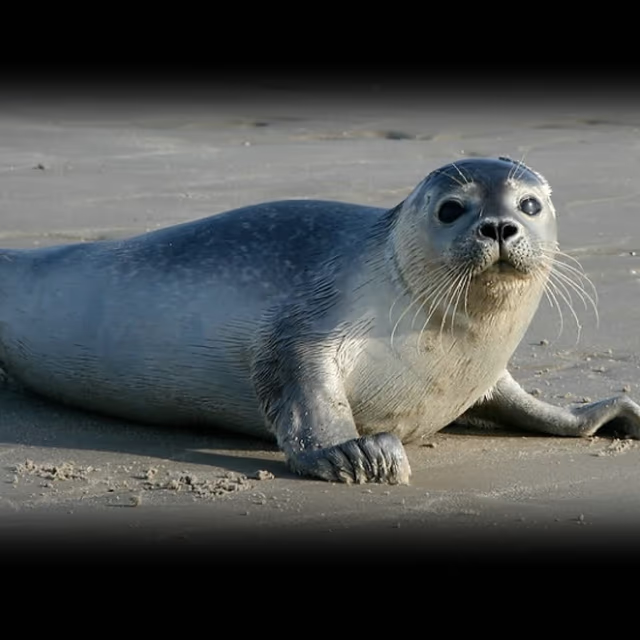
The International Day of Action Against Canadian Seal Slaughter is observed every March 15 to coordinate global opposition to Canada's commercial harp seal hunt, one of the largest annual marine mammal hunts on record. The observance gained urgency in 2003, when Canada's Department of Fisheries and Oceans registered SOR/2003-103, a management plan authorizing a Total Allowable Catch of 975,000 harp seals over three years — the highest quota in decades. Animal welfare organizations, led by the International Fund for Animal Welfare (IFAW) and Friends of Animals, responded by staging coordinated protests at Canadian consulates and public spaces across multiple countries. The date was deliberately set to correspond with the opening of the Canadian commercial seal hunting season off the coast of Newfoundland.

Advertisement
ORIGINS

International Day of Action Against Canadian Seal Slaughter history

INTRODUCTION

Canada's commercial harp seal hunt has been contested internationally since the 1960s, but its modern advocacy history begins in 1965 when Brian Davies, then executive secretary of the New Brunswick SPCA, was invited by the Canadian government to observe hunt conditions in the Gulf of St. Lawrence. Davies returned with a single conclusion: the hunt could not be made humane and should be ended entirely. In 1969 he founded the International Fund for Animal Welfare (IFAW), making the seal hunt the organization's first campaign.

The anti-sealing movement scored its first major legislative victory in 1983, when the European Economic Community banned imports of whitecoat harp seal and blueback hooded seal pelts, collapsing a key market and forcing a sharp contraction in the industry. For much of the late 1980s and early 1990s, annual kill numbers dropped significantly.

CHAPTER 01

The 2003 Quota Surge and the Birth of the Observance

In 2003, Canada's Department of Fisheries and Oceans registered SOR/2003-103, a three-year Atlantic Seal Hunt Management Plan authorizing a Total Allowable Catch of 975,000 harp seals, with up to 350,000 animals in any single year. The plan cited a recovered harp seal population of approximately 5.2 million animals. Conservation biologists and animal welfare organizations responded with alarm, describing the Canadian commercial hunt as the world's largest annual marine mammal slaughter, with more than one million seals killed between 2003 and 2006 under the plan.

This policy shift drove IFAW and allied organizations to escalate their public protest strategy. On February 28, 2004, IFAW staged the first documented International Day of Action at Grand Central Terminal in New York City, drawing over 100 demonstrators and coverage from several major television networks and newspapers. By 2005, Friends of Animals fixed the annual protest date at March 15, coordinating demonstrations at the Canadian Consulate General in Manhattan and parallel vigils across Europe, Central America, and South America. The March 15 date aligns with the opening of Canada's commercial seal hunt season off the coast of Newfoundland.

CHAPTER 02

Policy Outcomes and Campaign Evolution

Sustained protest pressure contributed directly to trade-level action. The EU adopted Regulation (EC) No 1007/2009 on September 16, 2009, banning the placement of seal products on the EU market. When Canada and Norway challenged the ban before the World Trade Organization, the WTO upheld it, making this the first WTO dispute resolved on the grounds of public morality and animal welfare. An estimated 36 international trade bans on seal products are now in place globally, and the commercial hunt has declined by approximately 90 percent compared to peak years. In 2020, only 440 seals were killed in the entire Newfoundland commercial hunt, the lowest figure on record.

The organizations coordinating the annual March 15 observance have included IFAW, Friends of Animals, HarpSeals.org, Humane Society International Canada, Sea Shepherd, and In Defense of Animals, each contributing demonstrations, petitions, or consumer boycott campaigns around the date.

TIMELINE

International Day of Action Against Canadian Seal Slaughter Timeline

IFAW founded to end seal hunt

Brian Davies founded the International Fund for Animal Welfare in New Brunswick, Canada, with stopping the commercial whitecoat seal hunt as the organization's first campaign.

Canada introduces seal hunt quota

After intensive commercial hunting in the 1950s and 1960s cut Northwest Atlantic harp seal numbers by more than half, Canada's government established a formal quota system to limit annual kills.

Europe bans whitecoat seal pelts

The European Economic Community banned the import of pelts taken from whitecoat harp seals and blueback hooded seals less than two weeks old, severely curtailing a major export market for Canadian sealers.

Canada sets 975,000-seal quota

Canada's DFO registered regulations SOR/2003-103, establishing a three-year Total Allowable Catch of 975,000 harp seals, the largest quota in decades and the direct catalyst for organized international protest days.

First Day of Action launches

IFAW organized the first International Day of Action Against Canadian Seal Slaughter on February 28 at Grand Central Terminal in New York City, drawing over 100 protesters and coverage from multiple major television stations and newspapers.

EU bans all seal products

The EU adopted Regulation (EC) No 1007/2009 on September 16, prohibiting seal products on the EU market; the World Trade Organization later upheld the ban in the first WTO dispute resolved on animal welfare and public moral grounds.

GET INVOLVED

How to Celebrate International Day of Action Against Canadian Seal Slaughter

EDITOR'S PICK

Attend or organize a protest at a Canadian consulate

Friends of Animals established the tradition of gathering at Canadian consulates on March 15 to deliver the message directly to the government overseeing the hunt. Friends of Animals coordinates international demonstrations and can connect you with local chapters or protest logistics near you.

SIGN

Sign and share IFAW's active petition to end the hunt

The International Fund for Animal Welfare has campaigned against the seal hunt since 1969 and maintains active petitions directed at Canadian federal officials. Visit IFAW's End the Seal Hunt campaign page to add your name and share the petition link with your network on March 15.

DONATE

Donate to a seal protection organization

Organizations like HarpSeals.org, a registered 501(c)(3) nonprofit, fund on-the-ice documentation and policy advocacy work throughout the year. Contributions support fieldwork during the hunt season, which runs from late February through May.

WRITE

Write directly to Canadian government officials

Canada's Department of Fisheries and Oceans sets the annual Total Allowable Catch for the commercial hunt, and public correspondence to the Minister of Fisheries and the Prime Minister's Office is one mechanism advocates have used to pressure quota reductions. Use March 15 to send a short, factual letter referencing the 2003-2005 management plan and the current hunt statistics as concrete grounds for policy change.

WATCH

Watch and share documented hunt footage

IFAW and Humane Society International have released footage from multiple hunt seasons showing on-ice conditions and regulatory compliance questions raised by independent veterinarians. Sharing verified footage from IFAW's documented campaign archive gives audiences primary visual evidence rather than secondhand summaries.

WHY THIS DAY MATTERS

Why International Day of Action Against Canadian Seal Slaughter is Important

It distinguishes commercial hunting from indigenous subsistence practice

The day's framing explicitly targets commercial-scale sealing, not the subsistence hunting practiced by Inuit communities, who use the whole animal for food and clothing year-round. By keeping that distinction public, the observance helps prevent conflation of indigenous practice with industrial-scale pelting operations, which target animals primarily for fur and discard carcasses on the ice.

It targets the world's largest marine mammal hunt

Conservation biologists have documented Canada's commercial harp seal hunt as the largest existing hunt for marine mammals anywhere on Earth, with more than one million seals killed between 2003 and 2006 under a single government-approved quota plan. The annual observance functions as a recurring checkpoint on that ongoing kill record, maintaining public pressure at a time when hunt numbers have fallen but no permanent ban exists.

It directly shaped binding international trade law

Coordinated campaign pressure from organizations marking this observance contributed to the EU's adoption of Regulation (EC) No 1007/2009, which banned seal products on the EU market and was later upheld by the WTO in the first-ever dispute settlement decided on animal welfare and public moral grounds. That legal precedent now governs 36 international trade bans affecting the sealing industry.

FOR MARKETERS & CREATORS

Turn every day into a moment your audience actually shows up for.

8.4M
Monthly readers
5K+
Holidays tracked