The Second Amendment's lineage extends centuries before 2A Day's founding. Its philosophical roots trace to the English Bill of Rights of 1689, which declared that Protestant subjects "may have arms for their defence suitable to their conditions and as allowed by law". That provision emerged from the political friction surrounding King James II's attempts to disarm Protestant dissenters while maintaining a standing army loyal to the Crown. When American colonists drafted their own constitutional protections, this English precedent shaped their approach.
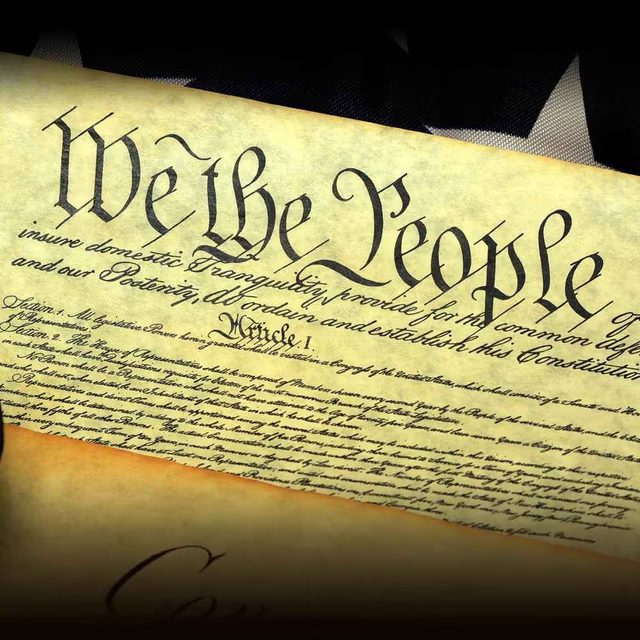
Pennsylvania became the first state to adopt an explicit right-to-bear-arms guarantee in its 1776 Constitution, declaring that "the people have a right to bear arms for the defence of themselves and the state". This language, drafted under a convention presided over by Benjamin Franklin, represented the first codified use of the phrase "right to bear arms" in American constitutional law. Other states followed, and when James Madison proposed the federal Bill of Rights in 1789, the Second Amendment emerged from this state-level tradition. Ratified on December 15, 1791, the Amendment read: "A well regulated Militia, being necessary to the security of a free State, the right of the people to keep and bear Arms, shall not be infringed".
For nearly two centuries, the scope of the Second Amendment remained largely unexamined by the Supreme Court. In United States v. Miller (1939), the Court upheld the National Firearms Act of 1934, ruling that a sawed-off shotgun bore no reasonable relationship to a well-regulated militia. The landmark shift came in District of Columbia v. Heller (2008), where the Court held 5-4 that the Amendment protects an individual right to possess firearms for traditionally lawful purposes, including self-defense in the home. Two years later, McDonald v. City of Chicago (2010) incorporated that right against state and local governments through the Fourteenth Amendment. In 2022, New York State Rifle & Pistol Association v. Bruen further expanded protections by striking down New York's "proper cause" requirement for concealed carry permits.
Against this backdrop, Deborah Lane created 2A Day in 2019 as a fixed annual observance on April 17, registered through the National Day Archives. The observance operates without a centralized governing body, relying instead on grassroots participation from gun owners, shooting ranges, and firearms advocacy organizations. In April 2025, the day gained Congressional visibility when Rep. Roger Williams introduced a House resolution with 16 original cosponsors, endorsed by the NRA and NSSF, reaffirming legislative support for the Second Amendment on 2A Day.