For Developers Holiday Deals For Business
National Banana Day

April 15

National Banana Day

A food observance celebrating bananas, highlighting their nutritional value, global agricultural significance, and cultural history.

Yearly Date
Third Wednesday in April
Observed in
United States
Category
Food
Subcategory
Fruit
Founding Entity

Unknown

First Observed
~2017
Origin

Community Origin

No documented founder or formal establishment record has been identified. One secondary source attributes the observance to Fyffes, an Irish fruit import company, around 2017, but no primary source confirms this claim.

Introduction

National Banana Day celebrates a fruit that defies its own reputation as ordinary. The banana plant is the world's largest herb, not a tree, and the fruit it produces is botanically classified as a berry. More than 100 billion bananas are consumed globally each year, making them the fourth most popular agricultural product on Earth.

Yet virtually every banana sold in a Western supermarket is an identical genetic clone. The Cavendish cultivar dominates international trade, and its total lack of genetic diversity has left the global supply vulnerable to a single fungal pathogen that has already spread across Asia, Africa, and Latin America with no known cure.

National Banana Day History

Bananas are among the oldest cultivated crops, first domesticated in Southeast Asia roughly 10,000 years ago. Traders carried them across the Indian Ocean to Africa and Polynesia, and Portuguese sailors introduced them to the Americas in the 16th century. By the late 1800s, the banana had become a global commodity.

The variety that built the modern banana industry was the Gros Michel, nicknamed "Big Mike." First recorded in Martinique in the 1830s, it offered a thick peel that resisted bruising, a creamy texture, and a sweet flavor so distinctive that artificial banana flavoring was reportedly modeled after it rather than the banana most people eat today.

Panama disease and the great banana switch

In the 1890s, a soil-borne fungus called Fusarium oxysporum began attacking Gros Michel plantations across Central America. The disease, known as Panama disease Race 1, spread through contaminated soil and water with no effective treatment. By the 1950s, the Gros Michel had been effectively wiped out as a commercial crop.

The industry replaced it with the Cavendish, a cultivar named after William Cavendish, the 6th Duke of Devonshire, whose gardener Joseph Paxton had first cultivated it in England in the 1830s. The Cavendish was resistant to Race 1 and became the global standard. Today, it accounts for nearly all internationally traded bananas.

A new threat with no known cure

In the 1990s, a new strain of the same fungus emerged in Taiwan. Tropical Race 4 attacks Cavendish bananas specifically and has since spread across Asia, the Middle East, Africa, and reached Colombia in 2019 and Peru in 2021. The fungus persists in soil for decades, and no fungicide, resistant commercial variety, or genetic modification has yet stopped it. Scientists estimate TR4 now threatens 80 percent of global banana production.

An observance with an unclear origin

National Banana Day began appearing on food calendars around 2017, with one source attributing the observance to Fyffes, an Irish fruit import company. No official announcement or formal establishment record has been located. The day has since been adopted by food bloggers, nutrition educators, and banana industry groups as an annual occasion to highlight the fruit's nutritional benefits and the agricultural challenges facing its production.

National Banana Day Timeline

327 BC

Alexander the Great encounters bananas

During his military campaign in India, Alexander the Great documented encountering banana plants, marking one of the earliest recorded Western observations of the fruit.
1830s

Gros Michel becomes the export standard

The Gros Michel banana, first recorded on the Caribbean island of Martinique, became the dominant variety for international trade due to its thick peel, sweet flavor, and resistance to bruising during shipment.
1950s

Cavendish replaces the Gros Michel

After Panama disease Race 1 devastated Gros Michel plantations across Central America, the banana industry shifted to the Cavendish cultivar, which was resistant to that particular fungal strain.
1990s

Tropical Race 4 emerges in Asia

A new strain of Panama disease, Tropical Race 4, was identified attacking Cavendish plantations in Taiwan, beginning a slow global spread that would eventually threaten the majority of world banana production.
2019

TR4 reaches Latin America

Colombia confirmed the first detection of Tropical Race 4 in the Americas, raising alarm across the world's largest banana-exporting region and triggering quarantine measures.

How to Celebrate National Banana Day

  1. 1

    Try a banana variety you've never tasted

    Seek out red bananas, apple bananas (Manzano), or plantains at your local international grocery store. Each variety offers a different flavor profile and texture. The Banana Link guide explores the diversity of banana varieties grown around the world.

  2. 2

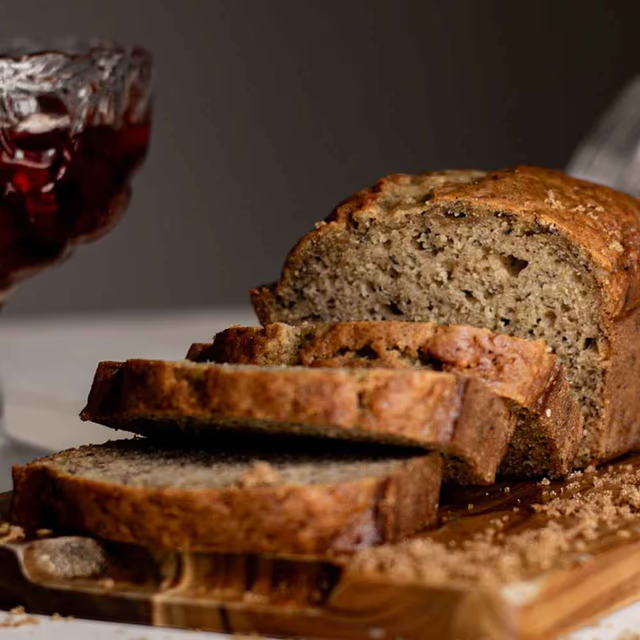
    Bake banana bread with overripe bananas

    Spotted, overripe bananas contain higher sugar concentrations that produce moister, more flavorful baked goods. The USDA estimates that Americans discard roughly 3.5 million tons of bananas annually, and banana bread is one of the most effective ways to use fruit that might otherwise be wasted.

  3. 3

    Learn about the Tropical Race 4 crisis

    The FAO World Banana Forum provides updates on TR4 containment efforts, quarantine protocols, and the research race to develop resistant varieties. Understanding the threat helps consumers appreciate why crop diversity matters.

  4. 4

    Support fair trade banana producers

    Look for Fairtrade-certified bananas at your grocery store. The certification guarantees a minimum price to growers and funds community development projects in producing countries like Ecuador, Colombia, and the Dominican Republic.

  5. 5

    Make frozen banana soft serve

    Blend frozen banana slices in a food processor until they reach a creamy, soft-serve consistency. No added sugar, dairy, or equipment beyond a basic food processor is needed. Add cocoa powder, peanut butter, or frozen berries to create different flavors from a single ingredient.

Why We Love National Banana Day

  • A

    A single disease could collapse global banana supplies

    Tropical Race 4 of Panama disease has no cure, no effective fungicide, and no commercially viable resistant banana variety. Because virtually all exported bananas are genetically identical Cavendish clones, the entire international supply chain is vulnerable to a single pathogen that has already reached every major growing continent.

  • B

    Bananas are a food security staple for 400 million people

    Global banana production reached 139.6 million tonnes in 2022, with India alone producing 26 percent of the total. In tropical regions of Africa, Asia, and Latin America, cooking bananas and plantains provide a primary source of calories and essential nutrients including potassium, vitamin B6, and vitamin C.

  • C

    The genetic diversity crisis demands attention

    Over 1,000 banana varieties exist worldwide, but commercial agriculture relies almost exclusively on a single clone. National Banana Day highlights the contrast between wild banana diversity and the monoculture that dominates global trade, drawing attention to breeding programs working to develop disease-resistant varieties before TR4 arrives in more regions.

How well do you know National Banana Day?

Question 1 of 8

What type of plant produces bananas?

Holiday Dates

Year Date Day
2023 Wednesday
2024 Wednesday
2025 Wednesday
2026 Wednesday
2027 Wednesday