Holiday Calendar

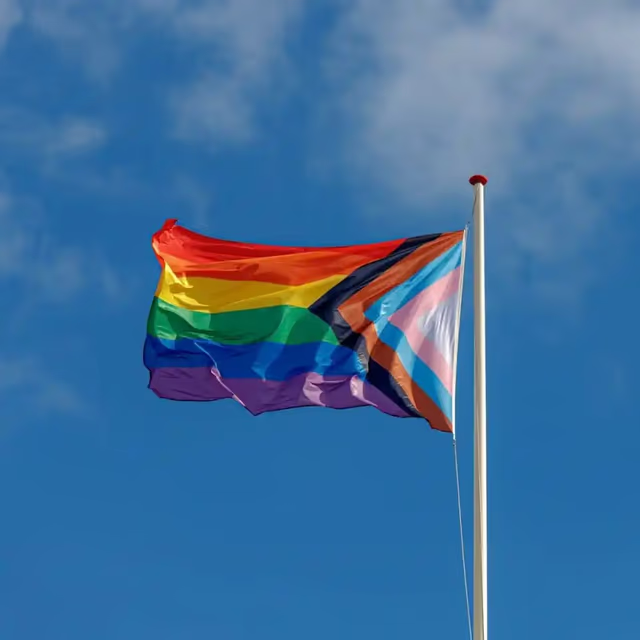
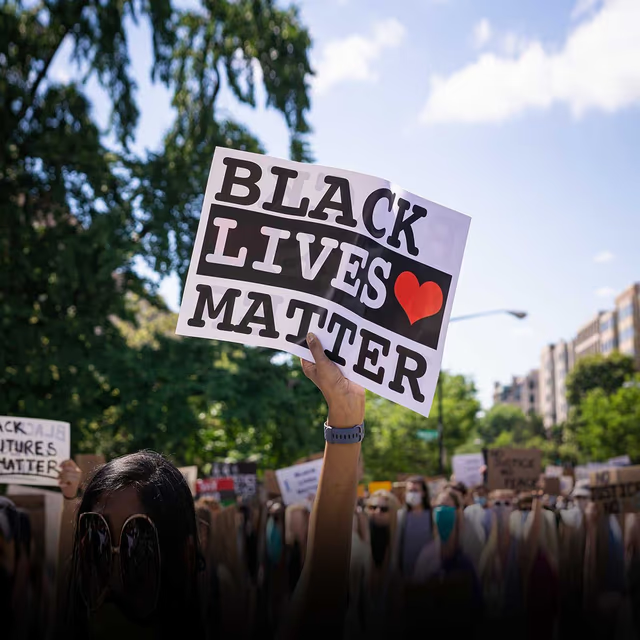
Black Lives Matter Month

Next celebratedTuesday, June 1, 2027

An informal awareness observance held throughout June in the United States, promoting reflection on racial justice, police accountability, and the experience of Black Americans.

Countdown to the day
--DAYS
--HRS
--MIN
--SEC
Last updated February 26, 2026 · by the Holiday Calendar TeamHave an update or spot an error?
YEARLY DATEAll of June
OBSERVED INUnited States
CATEGORYAwareness
SUBCATEGORYSocial Justice
ORIGIN

CommunityOrigin

FOUNDING ENTITY
Not documented
FIRST OBSERVED
Not documented
HOW THE HOLIDAY CAME TO BE

A month with no founder, drawn from a documented movement.

The June observance of Black Lives Matter Month has no documented founder or formal proclamation in primary sources; it circulates through community and local-government proclamations, advocacy groups, and holiday-listing sites rather than a single establishing act. It draws on the Black Lives Matter movement, which Encyclopaedia Britannica and the movement's own organization date to 2013.

+ Know the story? Submit a founder Help us complete this holiday
INTRO

The June observance a documented movement never named

The Black Lives Matter movement keeps its own calendar, and the date it marks is not in June. The organization behind the movement circulates a proclamation template that asks cities to recognize July 13 as Black Lives Matter Day, the anniversary of the hashtag that started it all. Black Lives Matter Month, observed across June in the United States, comes from somewhere else.

No founder, no proclamation, and no single establishing act is on record for the June observance. It spread instead through local-government recognitions, advocacy groups, and holiday listings, an informal designation the movement itself does not officially reference. That gap is the honest starting point for the page.

What the June month borrows is a far better documented story. Encyclopaedia Britannica dates the movement to 2013 and, after the murder of George Floyd in 2020, calls the protests that followed the largest protest movement in American history, with an estimated 15 million to 26 million participants.

Advertisement
ORIGINS

Black Lives Matter Month history

CHAPTER 01

A name born from an acquittal

The phrase entered American politics on a specific date. On July 13, 2013, hours after George Zimmerman was acquitted in the killing of Trayvon Martin, the Oakland activist Alicia Garza wrote a Facebook post that ended with the words "Our lives matter." Her friend Patrisse Cullors reshared it with a hashtag, and Opal Tometi joined them to build a network, according to HISTORY's account of that day.

The trigger had come more than a year earlier. Trayvon Martin, an unarmed 17-year-old, was shot and killed in Sanford, Florida, on February 26, 2012. Britannica records that Zimmerman, a neighborhood-watch volunteer, was acquitted in July 2013 in a verdict widely perceived as a miscarriage of justice.
CHAPTER 02

From hashtag to streets

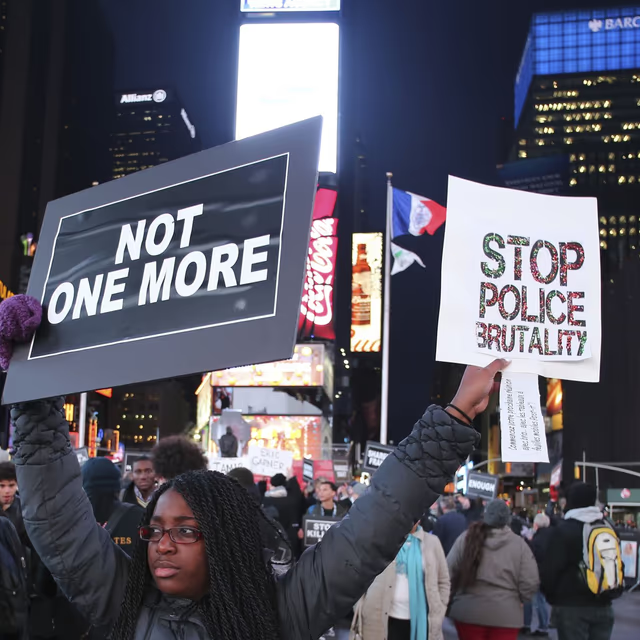
The movement grew through grief rather than through any office. Britannica writes that it expanded in 2014 after the police killings of two unarmed Black men, Eric Garner in Staten Island, New York, and Michael Brown in Ferguson, Missouri, and that the refusal of prosecutors to bring charges drew national and international attention.

It has no headquarters in the usual sense. Britannica describes a decentralized grassroots movement led by activists in local chapters that affiliate with the Black Lives Matter Global Network Foundation, a nonprofit active in the United States, Canada, and the United Kingdom.

CHAPTER 03

The June month, and what it is not

This is where the observance and the movement part ways. The movement's own proclamation marks July 13. June, by contrast, carries a month-long awareness designation that circulates through community usage and is reported in places such as local news coverage of June 1, but that no primary record traces to a single creator.

It is also not Black History Month, which the United States observes in February. Keeping the two apart matters: one is a long-established heritage month, the other an informal June observance attached to a contemporary movement. The June month's strength is the documented record it points back to, not a founding story of its own.

TIMELINE

Timeline

Trayvon Martin is killed

Trayvon Martin, an unarmed 17-year-old, is shot and killed in Sanford, Florida, on February 26, the case that would later prompt the movement, per HISTORY.

The hashtag appears

After George Zimmerman's acquittal, #BlackLivesMatter is coined on July 13 by Alicia Garza, Patrisse Cullors, and Opal Tometi, according to HISTORY.

Protests spread

Britannica records that the deaths of Eric Garner in New York and Michael Brown in Ferguson, Missouri, draw national protests and bring the movement to prominence.

George Floyd protests

After George Floyd's murder on May 25, an estimated 15 million to 26 million people join US protests, described as the largest in US history, per Wikipedia's summary of a New York Times analysis.

A rare conviction

Derek Chauvin is found guilty of Floyd's murder, which Britannica notes was a rare case of police violence resulting in a conviction.

Support settles lower

A Pew Research Center survey finds support for the movement at 52 percent, down from a 67 percent peak in June 2020.

GOOD TO KNOW

Surprising facts about Black Lives Matter Month

The movement marks July, not June

The Black Lives Matter organization's own proclamation template designates July 13 as Black Lives Matter Day, the hashtag's anniversary, which makes the separate June month a community observance the movement does not officially reference.

A hashtag used 44 million times

Pew Research Center found #BlackLivesMatter was used more than 44 million times on Twitter over its first decade, peaking at more than 1.2 million uses in a single day during the summer of 2020.

Possibly the largest protests in US history

Britannica describes the 2020 protests as the largest protest movement in American history, with an estimated 15 million to 26 million participants drawn from a New York Times analysis.

A million uses in one day

Pew Research Center found #BlackLivesMatter was used more than 1.2 million times on a single day during the summer of 2020, and averaged about 160,000 uses a day across that surge.

A rare conviction followed

Britannica notes that Derek Chauvin's 2021 murder conviction in the death of George Floyd was a rare case of police violence resulting in a conviction.

WHY THIS DAY MATTERS

Why Black Lives Matter Month Matters

Scale

An estimated 15 million to 26 million people joined the 2020 protests, which Britannica calls the largest protest movement in American history.

The June observance points back to events of unusual size. Britannica reports that the 2020 protests after George Floyd's murder drew an estimated 15 million to 26 million participants, a figure that originates from a New York Times analysis of four polls.

Division

Public opinion has never been uniform

Public opinion on the movement has never been uniform. A Pew Research Center survey conducted June 4 to 10, 2020, found 67 percent of US adults supported it, but support ran from 86 percent of Black adults and 91 percent of Democrats to 60 percent of White adults and 40 percent of Republicans.

Dispute

Its impact is openly contested

The movement's impact is itself contested. Britannica notes that critics' claims ranged from disputing that systemic racism exists to alleging the movement encouraged violence against police, and that opposition groups including Blue Lives Matter and White Lives Matter formed in response.

BY THE NUMBERS

Black Lives Matter Month by the Numbers

15M-26M
Participants in 2020 US protests
4,700+
US demonstrations by end of June 2020
67%
US adults supporting BLM, June 2020
52%
US adults supporting BLM, early 2025
44M+
#BlackLivesMatter tweets over a decade

GET INVOLVED

How to Observe Black Lives Matter Month

EDITOR'S PICK

Learn the documented timeline

Read an encyclopedic account of the movement from 2013 onward rather than a social-media summary. Britannica and Pew Research Center both maintain sourced, regularly updated overviews.

READ

Read the original survey data

Look at how American opinion has shifted instead of relying on a single headline. Pew Research Center publishes the full numbers, including the breakdowns by race and party, with its methodology.

DISTINGUISH

Distinguish the observances

Note that June's awareness month is separate from Black History Month in February and from the movement's own July 13 Day. Keeping the three distinct is part of understanding any of them.

REFLECT

Reflect on the named record

Take time with the specific cases the sources document, including Trayvon Martin, Eric Garner, Michael Brown, and George Floyd. Reading the record closely is more honest than a general gesture.

WEIGH

Weigh more than one view

Sit with the disagreement the data shows rather than only the side you already hold. Britannica lays out both the support for the movement and the criticism it has drawn.

GET INVOLVED

Resources and Support

PEW

Pew Research Center

Pew Research Center. Survey data on US opinion of the movement, with race and party breakdowns.

ENCYCLOPAEDIA

Encyclopaedia Britannica

Encyclopaedia Britannica. A sourced encyclopedic overview of the movement's history, goals, and criticism.

Test your knowledge

How well do you know Black Lives Matter Month?

1 / 8

What date does the Black Lives Matter organization's own proclamation template designate?

Answer

No. It is an informal awareness observance with no federal proclamation and no documented founder. It circulates through community usage and some local-government recognitions rather than any single establishing act.

COLOPHON

Sources

How we know what’s on this page. References, not endorsements.

10sources
5primary records
5independently dated
Primary records
Additional coverage
FOR MARKETERS & CREATORS

Turn every day into a moment your audience actually shows up for.

8.4M
Monthly readers
5K+
Holidays tracked