Holiday Calendar
559 saved#96 of 6,224

Berries and Cherries Month

A food observance held throughout March celebrating berries and cherries, their place in American eating, and the produce that grows them.

Monday
1–31
March 2027
Last updated February 26, 2026 · by the Holiday Calendar Team
Have an update or spot an error?
YEARLY DATEAll of March
OBSERVED INUnited States
CATEGORYFood
SUBCATEGORYFruit
ORIGIN

Community Origin

FOUNDING ENTITY
Not documented
FIRST OBSERVED
Not documented
HOW THE HOLIDAY CAME TO BE

A food month with no documented author.

No authoritative source documents who created Berries and Cherries Month, when it began, or why March was chosen. It circulates as an undocumented US food observance, kept alive mainly by produce-industry and agricultural-extension accounts.

+ Know the story? Submit a founder Help us complete this holiday
INTRO

The fruit names that botany refuses to honor

Start with a small embarrassment. Most of the fruit in the name of this month is not what the name says it is. A strawberry is not a true berry. A raspberry is not a berry either. And a cherry is not even close.

To a botanist, a true berry is a fleshy fruit that grows from a single ovary in one flower and holds its seeds inside. By that test, blueberries and cranberries qualify, and so do bananas, tomatoes, and eggplants. The strawberry does not. Its red flesh is a swollen flower base, and the tiny "seeds" dotting the outside are the real fruits.

Cherries fail the test for a different reason. They carry a single hard stone, which makes them drupes, the same family as peaches and olives. Berries and Cherries Month, observed across March in the United States, celebrates a basket of fruit that mostly refuses to sit in the category we filed it under. That contradiction is the fun of it, not a flaw to fix.

Advertisement
ORIGINS

Berries and Cherries Month history

INTRODUCTION

Begin with the word "berry," which everyday English and botany have never agreed on. The kitchen calls anything small, soft, and sweet a berry. Botany asks for proof, and most of the fruit in this month cannot supply it.

That argument is older than any holiday. Long before March got a fruit observance, gardeners and grocers were already sorting the real berries from the impostors, and the line they drew rarely matched the menu.

CHAPTER 01

What actually counts as a berry

The botanical test is strict. A true berry develops from one flower with a single ovary, and it keeps its seeds inside soft flesh. The University of California's master gardeners list blueberries, cranberries, huckleberries, and gooseberries as the genuine article.

Then the list gets strange. By the same rule, bananas, tomatoes, kiwis, and eggplants are berries too. None of them ever made it into the name of a fruit month.
CHAPTER 02

Why strawberries and cherries get demoted

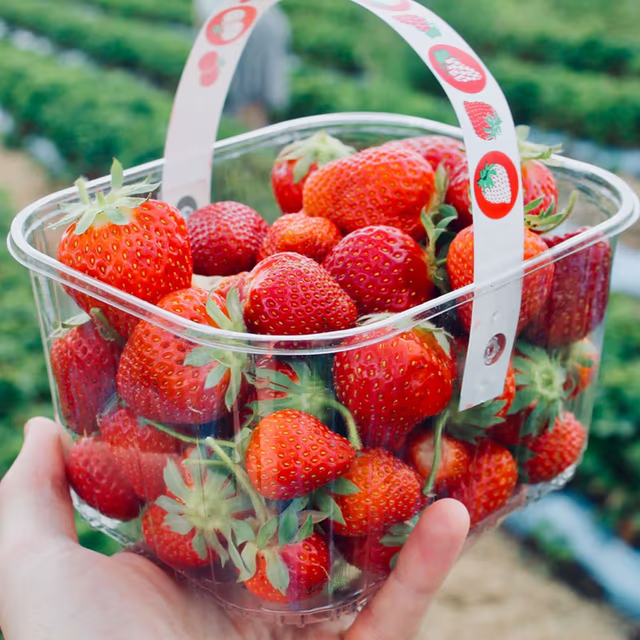
The popular fruits are the ones that fall out. A strawberry grows its true fruits, the achenes, on the outside of an enlarged flower base, which makes it an accessory fruit, not a berry. Raspberries and blackberries are clusters of tiny drupelets, each with its own seed.

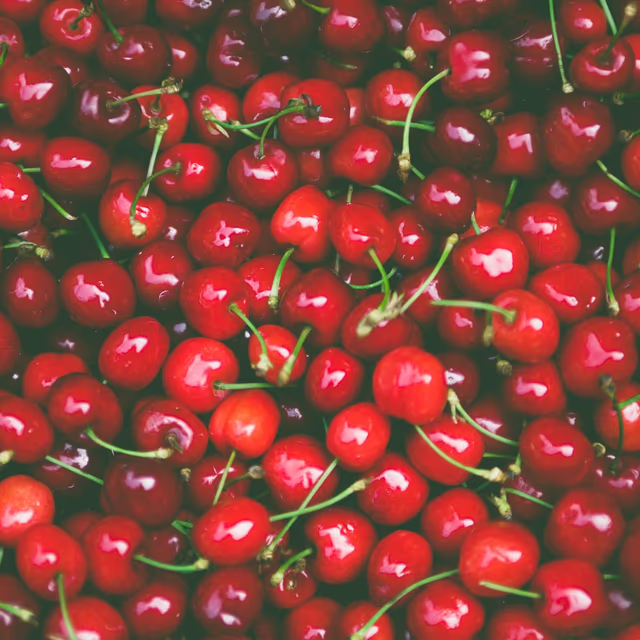
Cherries are stone fruit. They hold one seed in a hard pit, so botany files them as drupes. The name "Berries and Cherries" quietly admits the split, since cherries get their own word rather than being folded into "berries."

CHAPTER 03

The crop behind the name

Whatever the labels, the harvest is real and large. Michigan grows roughly three-quarters of the country's tart cherries, most of them in the orchards near the Great Lakes. Blueberries, a true berry, have become one of the fastest-rising fruits in the American diet.

The month sits on top of that industry without anyone documenting how it got there. No founder, no proclamation, and no record of why March was chosen survives in any reliable source. The fruit is easy to trace. The holiday is not.

AT A GLANCE

Berry vs cherry, botanically

True berry
Fleshy fruit from one ovary, seeds inside (blueberry, cranberry)
Strawberry
Accessory fruit; its 'seeds' are the real fruits
Raspberry, blackberry
Aggregate of tiny drupelets, each with a seed
Cherry
Drupe (stone fruit), one hard seed, like peach and olive
Surprise berries
Bananas, tomatoes, kiwis, and eggplants all qualify

WHY THIS DAY MATTERS

Why We Love Berries and Cherries Month

LITERACY

The fruit you call a berry probably is not one.

The month rewards anyone who asks what a fruit really is, since most of its namesakes flunk the textbook definition of a berry. A strawberry is an accessory fruit and a cherry is a drupe, which is the kind of thing the day exists to surface.

NUTRITION

It points to fruit rich in plant antioxidants

Harvard's Nutrition Source names anthocyanins in blueberries and strawberries among the phenolic antioxidant compounds in produce. The same source notes these work best as part of whole foods rather than as high-dose supplements.

ECONOMY

It celebrates a real slice of US farming

These fruits are not a niche crop. Most cultivated US blueberries are sold fresh rather than processed, and the strawberry and cherry harvests anchor whole farming regions. The month quietly sits over a working piece of American agriculture.

BY THE NUMBERS

Berries and Cherries Month by the Numbers

789.5M lbs ($1.15B)
US cultivated blueberries, 2024 record
~90%
US strawberries grown in California
7.9 lbs
Fresh strawberries eaten per US person, 2013
371,000 t
US sweet cherry crop, 2023 USDA forecast
203M lbs
US tart cherry crop, 2023 USDA forecast

GOOD TO KNOW

Surprising facts about Berries and Cherries Month

A raspberry is dozens of fruits in a clump

Each tiny bead on a raspberry or blackberry is its own drupelet, with its own seed. The fruit you pick is an aggregate of them, not one berry.

About a tenth of US blueberries grow wild

Roughly 90.8 million pounds of the 2024 crop were wild lowbush blueberries, and most of those went to processing rather than the fresh aisle.

The color is a chemical, not just a look

The deep red, purple, and blue of berries comes from anthocyanins, the same family of plant pigments that also tint grapes, plums, and red cabbage.

Cherries and almonds are botanical cousins

A cherry is a drupe, a fleshy fruit around a single hard stone, which groups it with peaches, plums, and olives rather than with blueberries.

GET INVOLVED

How to Celebrate Berries and Cherries Month

EDITOR'S PICK

Run a true-berry taste test

Set out blueberries, strawberries, raspberries, and a cherry, then sort them into true berries and impostors. Only the blueberry passes, which makes the point faster than any explanation.

BAKE

Bake with cherries and stone fruit

Pit a bowl of cherries for a pie or a crumble and notice the single hard stone in each one. That stone is exactly why a cherry counts as a drupe and not a berry.

SHOP

Shop a winter produce aisle

Since fresh US cherries and berries peak in summer, March is a good month to compare frozen, dried, and imported options. Taste the difference between a summer berry and an out-of-season one.

TEACH

Teach a kid the berry rule

Explain that a banana and a tomato are berries while a strawberry is not, then watch the argument start. The botany sticks better as a surprise than as a lecture.

COOK

Cook one true berry and one false one

Make a blueberry compote and a strawberry shortcake side by side. You will be cooking a real berry and an accessory fruit in the same afternoon.

Test your knowledge

How well do you know Berries and Cherries Month?

1 / 10

What does a fruit need to be a true berry, botanically?

Answer

It runs through the entire month of March in the United States.

FOR MARKETERS & CREATORS

Turn every day into a moment your audience actually shows up for.

8.4M
Monthly readers
5K+
Holidays tracked