Holiday Calendar

National Pig Day

Next celebratedMonday, March 1, 2027

An unofficial appreciation day on March 1 that celebrates the domestic pig and the animal's intelligence, history, and place in everyday life.

Countdown to the day
--DAYS
--HRS
--MIN
--SEC
Last updated February 26, 2026 · by the Holiday Calendar TeamHave an update or spot an error?
YEARLY DATEMarch 1
OBSERVED INUnited States
CATEGORYAnimals
SUBCATEGORYFarm Animals
ORIGIN

Individual Initiative

FOUNDING ENTITY
Ellen Stanley and Mary Lynne Rave
FIRST OBSERVED
1972
Two sisters registered March 1 as Pig Day in 1972, hoping to win the animal a little respect.
HOW THE HOLIDAY CAME TO BE

Two sisters set out to give the pig its due.

Sisters Ellen Stanley, a teacher in Lubbock, Texas, and Mary Lynne Rave of Beaufort, North Carolina, created the day in 1972 and registered March 1 as Pig Day in Chase's Calendar of Annual Events. Their stated aim was to give the pig its rightful, though generally unrecognized, place as one of the most intelligent and domesticated animals.

INTRO

The day a barnyard animal got its own holiday

<![CDATA[

Put a young pig in a pen with a mirror and something strange happens. After a few hours of looking, the pig figures out what the reflection is for. In one published experiment, researchers showed pigs a food bowl that was visible only in a mirror, tucked out of sight behind a solid barrier. Seven of the eight pigs turned away from the glass, walked around the wall, and found the food in an average of about 23 seconds. The animals that had never met a mirror simply searched behind it.

That is the kind of pig that National Pig Day was invented to celebrate. Every March 1, the day asks people to look past bacon and barnyard cartoons and notice the animal itself: curious, social, and quietly clever. It is not a public holiday, and there is no parade. It is an appreciation day, and its whole premise is that the pig has been badly underrated.

The two sisters who started it in 1972 said as much in plain words. They wanted to hand the pig its "rightful, though generally unrecognized, place." More than fifty years of cognition research has since taken their hunch seriously.

]]>

Advertisement
ORIGINS

Pig Day history

INTRODUCTION

CHAPTER 01

From wild boar to barnyard

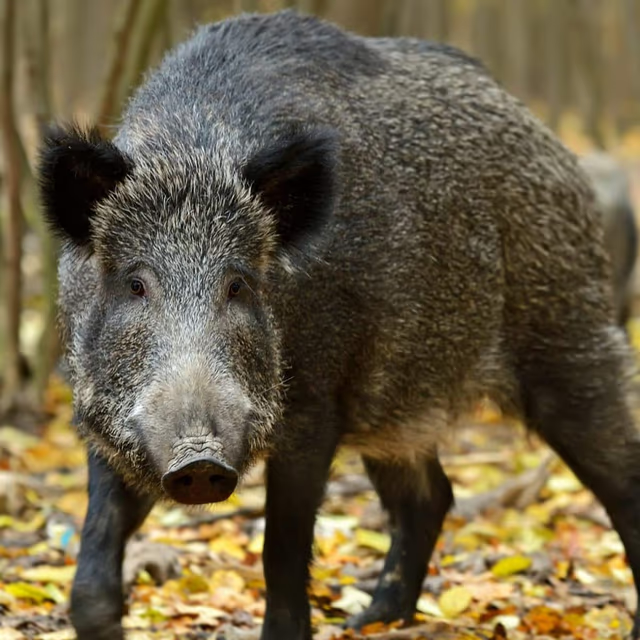
The animal at the center of the day is one of the oldest partnerships between people and a large mammal. The domestic pig, Sus scrofa domesticus, descends from the wild boar, Sus scrofa, and the change from one to the other happened a very long time ago. Encyclopaedia Britannica dates the domestication of the pig to roughly 9,000 years ago, most likely in what is now Turkey.

It was not a single event in a single place. Pigs were tamed more than once. In China's Lower Yangtze region, archaeological evidence shows pig domestication was underway by about 8,000 years ago, developing alongside the first rice farms and settled villages. Two ancient human communities, on opposite sides of the continent, arrived at the same idea.
CHAPTER 02

A traveler and a global animal

For most of history pigs and people moved together. Domestic pigs reached the Americas with European ships; Britannica notes they are believed to have arrived on Christopher Columbus's second voyage in 1493. Centuries of selective breeding followed, and by the 18th century Britain had produced the Yorkshire, or Large White, which went on to become the world's most popular breed. The wild boar's surly cousin had become a creature of farms on every continent.

CHAPTER 03

Two sisters and a calendar

The holiday itself is much younger, and its origin is refreshingly small in scale. In 1972 two sisters decided the pig deserved a day. Ellen Stanley taught school in Lubbock, Texas; her sister, Mary Lynne Rave, lived in Beaufort, North Carolina. Together they registered March 1 as "Pig Day" in Chase's Calendar of Annual Events, the reference book that catalogs observances.

Stanley, the teacher, brought the new holiday into her own classroom, and the day spread mostly through schools, zoos, and word of mouth, with its strongest following in the American Midwest. There was no sponsor and no campaign. The sisters simply named a day, wrote down a reason, and let it travel.

]]>

TIMELINE

Timeline

The wild boar becomes the pig

Wild boar (Sus scrofa) are domesticated into the domestic pig, most likely in present-day Turkey, beginning one of the longest partnerships between people and a large mammal.

A second domestication in China

In the Lower Yangtze region, pig domestication is underway alongside early rice cultivation and settled village life, an event independent of the one in the Near East.

Two sisters create the day

Ellen Stanley and Mary Lynne Rave register March 1 as Pig Day in Chase's Calendar of Annual Events, aiming to give the animal its overdue recognition.

Pigs read a mirror

A study by Donald Broom, Hilana Sena and Kiera Moynihan shows that pigs can use a mirror image to locate food hidden behind a barrier.

A review of the thinking pig

Lori Marino and Christina Colvin publish Thinking Pigs, a comparative review concluding that pigs are cognitively complex.

Pigs play a video game

Candace Croney and Sarah Boysen report that pigs at Purdue learned to move an on-screen cursor with a joystick, performing above chance.

AT A GLANCE

The domestic pig at a glance

Scientific name
Sus scrofa domesticus
Wild ancestor
The wild boar, Sus scrofa
First domesticated
Roughly 9,000 years ago
Breeds worldwide
More than 300
Most popular breed
Yorkshire, or Large White
Kept as
Livestock and, in smaller breeds, household pets

BY THE NUMBERS

National Pig Day by the Numbers

~9,000 yrs
Since pigs were first domesticated
300+
Pig breeds worldwide
962 million
Pigs living worldwide in 2024
7 of 8
Pigs that used a mirror to find hidden food

WHY THIS DAY MATTERS

Why We Love National Pig Day

Science

Pigs are cognitively complex and share many traits with animals whom we consider intelligent.

When Ellen Stanley and Mary Lynne Rave called the pig one of the most intelligent domesticated animals, it was an affectionate claim with little hard evidence behind it. The science has since caught up. The peer-reviewed review Thinking Pigs, by Lori Marino and Christina Colvin, concluded that pigs are cognitively complex and share many traits with animals we already consider intelligent, spanning self-awareness, social behavior, emotion, and personality. Some of the specific results are startling: at Purdue, Candace Croney and Sarah Boysen even trained pigs to move an on-screen cursor with a snout-operated joystick, a task once studied mainly in primates.

Companionship

The same animal is a pet and a farm staple

Pigs occupy an unusual double life. Smaller breeds such as the Vietnamese potbellied pig became popular companion animals living in homes, while their larger relatives remain one of the most common farm animals on earth. National Pig Day is a rare moment to consider the whole animal at once, rather than only the half people happen to live near.

Recognition

A small day with a clear purpose

There is no governing body, no sponsor, and no official status behind National Pig Day. It is carried by schools, zoos, and sanctuaries that take a single afternoon to point at an animal most people overlook. The point is appreciation: a day built entirely around noticing something familiar more carefully.

GET INVOLVED

How to Celebrate National Pig Day

EDITOR'S PICK

Visit pigs in person

Spend part of March 1 where pigs actually live. A farm, a petting zoo, or an animal sanctuary lets you watch the curiosity and social behavior the science describes, instead of reading about it.

LEARN

Learn one real fact about pig minds

Read up on the mirror study or the joystick experiments and share what you find. The day was built to spread exactly this kind of recognition, so passing on a genuine fact is squarely in its spirit.

MEET

Meet the many breeds

With more than 300 breeds worldwide, the pig is far more varied than the pink cartoon suggests. Look up the Yorkshire, the Duroc, or the potbellied pig and notice how different they are.

BRING

Bring it into a classroom

Ellen Stanley first celebrated the day with her own students. Teachers can follow her lead with a short lesson on domestication, animal cognition, or where pigs fit in the wider animal world.

GIVE

Give pigs a little credit

The simplest way to mark the day is to do what the founders asked: set aside the stereotypes for a moment and appreciate the pig as the clever, sociable animal it is.

MYTH VS FACT

Common Misconceptions

The myth

Pigs are dirty, dim-witted animals.

The truth

The reputation is unearned. Peer-reviewed work, including Marino and Colvin's review Thinking Pigs, finds the domestic pig to be cognitively complex, with documented abilities in memory, learning, and social behavior.

The myth

Pigs are scientifically proven to be smarter than a three-year-old child or a dog.

The truth

That popular line overstates the evidence. Researchers describe pigs as cognitively complex and compare specific skills carefully, but exact age or species rankings are a media shorthand, not a settled scientific finding. The defensible claims are concrete results like the mirror and joystick studies.

Test your knowledge

How well do you know National Pig Day?

1 / 8

Who created National Pig Day?

Answer

National Pig Day is observed every year on March 1.

COLOPHON

Sources

How we know what’s on this page. References, not endorsements.

8sources
5primary records
6independently dated
Primary records
International Journal of Comparative Psychology2015
Thinking Pigs: A Comparative Review of Cognition, Emotion, and Personality in Sus domesticus
Peer-reviewed review by Lori Marino and Christina Colvin (2015) concluding that domestic pigs are cognitively complex across self-awareness, social and nonsocial cognition, emotion, and personality.
View source
Animal Behaviour (Elsevier)2009
Pigs learn what a mirror image represents and use it to obtain information
Study by Donald Broom, Hilana Sena and Kiera Moynihan (2009) reporting that seven of eight pigs used a mirror to locate food hidden behind a barrier in a mean of about 23 seconds, while naive pigs searched behind the mirror.
View source
Frontiers in Psychology2021
Acquisition of a Joystick-Operated Video Task by Pigs (Sus scrofa)
Study by Candace Croney and Sarah Boysen (2021, Purdue) showing pigs learned to move an on-screen cursor with a joystick to hit targets, performing above chance on a task previously studied in primates.
View source
Proceedings of the National Academy of Sciences2025
Early evidence for pig domestication (8,000 cal. BP) in the Lower Yangtze, South China
Peer-reviewed research showing pig domestication was underway in China's Lower Yangtze region by about 8,000 years ago, developing alongside early rice cultivation.
View source
Our World in Data (FAOSTAT)2024
Number of pigs
FAOSTAT livestock data, processed by Our World in Data, giving the global pig head count of roughly 962 million in 2024.
View source
Additional coverage
FOR MARKETERS & CREATORS

Turn every day into a moment your audience actually shows up for.

8.4M
Monthly readers
5K+
Holidays tracked