Holiday Calendar

National Strawberry Day

Next celebratedSaturday, February 27, 2027

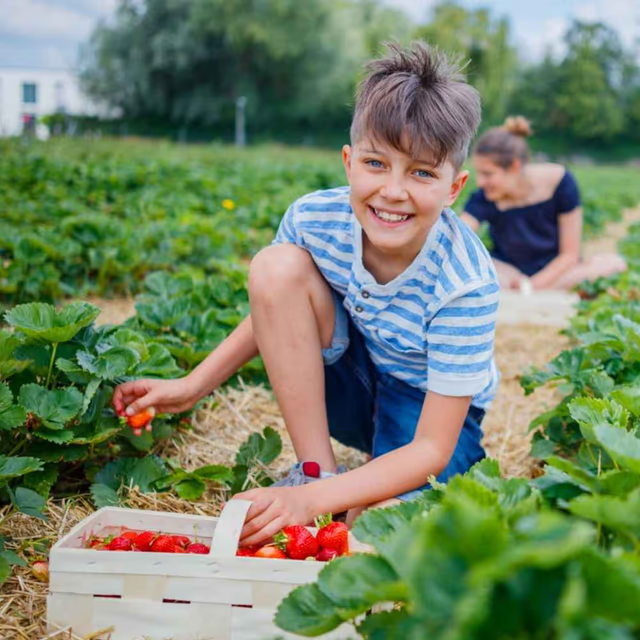
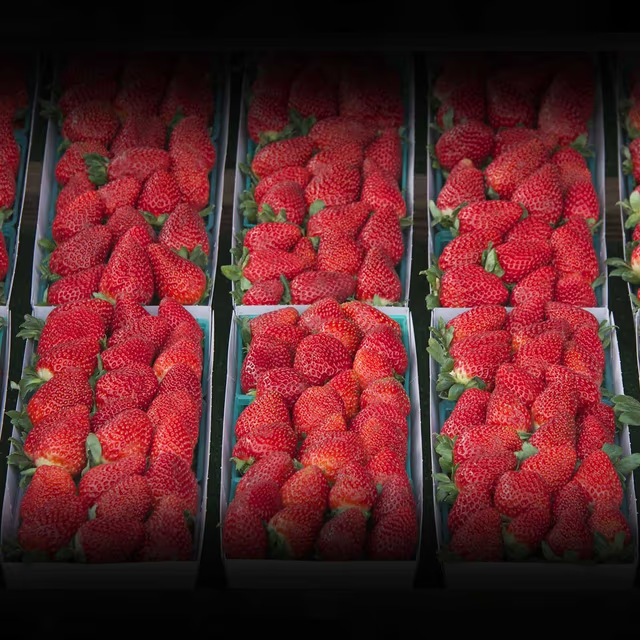
National Strawberry Day gives a whole day to the berry that usually turns up as somebody else's ingredient. Eat a box of them plain, before anyone can put them on top of something.

Countdown to the day
--DAYS
--HRS
--MIN
--SEC
Have an update or spot an error?
YEARLY DATEFebruary 27
OBSERVED INUnited States
CATEGORYFood
SUBCATEGORYFruit
ORIGIN

Community Origin

FOUNDING ENTITY
Not documented
FIRST OBSERVED
Not documented
HOW THE HOLIDAY CAME TO BE

The name is older than the observance.

No founder, proclamation or establishing record for a February 27 National Strawberry Day was located in the indexes searched. The earliest record found is a holiday listing archived on 2 December 2013, headed simply Strawberry Day, which credits no one and cites nothing.

+ Know the story? Submit a founder Help us complete this holiday
INTRO

The strawberry needed two continents and a royal garden

A California newspaper reported in June 1885 that the fruit dealers of Arkansas observed Thursday week as Strawberry Day. The archive cuts the sentence off before it says who received the fruit they gave away. National Strawberry Day, the version that now falls on February 27, appears nowhere in that archive at all.

Search those California papers from 1850 to 1990 and the plain phrase turns up 193 times. The modern name returns zero. The word is old, in other words, and the observance is not.

Neither is the fruit, which is the stranger half of the story. The plant behind a supermarket punnet is a newcomer. Getting it there took a Chilean garden, a French army engineer and a teenage botanist at Versailles.

Advertisement

DEALS & OFFERS

2026’s deals have wrapped

See who celebrated this year, and browse offers from past years.

ORIGINS

Strawberry Day history

INTRODUCTION

The strawberry that mattered grew in Chile, long before any of this had a calendar date. The Picunche, north of the Biobio River, and the Mapuche to its south cultivated strawberries more than 1,000 years ago. Both white and red fruited forms were domesticated, and the white may have been preferred for its size.

Nothing about the modern berry was inevitable. Two plants that grew a hemisphere apart had to reach the same country first.

CHAPTER 01

Five plants off a six-month voyage

Amedee Francois Frezier was an engineer in the French Army Intelligence Corps, sent by Louis XIV to make a reconnaissance of Chile and Peru. The king was apparently determined to keep his grandson on the Spanish throne. Frezier was no botanist, but in George Darrow's phrase he had the botanist's impulse for collecting.

He came home with plants. As the story goes, he nursed them on limited water across a six-month voyage and landed five at Marseille. Two went to the ship's owner, one to the Royal Garden, one to the minister of fortifications, and he kept the last.

CHAPTER 02

The teenager who drew the family tree

Antoine Nicolas Duchesne reached strawberries in 1761, at Versailles, where his father was superintendent of the king's buildings. He picked a single-leafleted plant out of a bed of ordinary three-leafleted ones and sent it to Linnaeus, who published it as Fragaria monophylla.

Only female Chilean plants had reached Europe, so they fruited badly. In 1764 Duchesne pollinated them with pollen from another species, and the berries won him an audience with Louis XV.

He was 19 when Histoire naturelle des fraisiers appeared in 1766. It carried a drawn genealogy of the genus, since regarded as the second published phylogenetic network, and its central hypothesis was later proved right.

CHAPTER 03

Strawberry Day before it was national

American towns were doing this a century ago, in the fruit's own season. Gardena, California, billed a Strawberry Day for Saturday 6 May 1916, with a seventy-five-mile automobile race as the draw. Riverside was invited by advertisement.

CHAPTER 04

A day with no author

Nothing that careful attaches to February 27. The earliest record located for the modern observance is a holiday listing archived in December 2013, headed simply Strawberry Day. It named no founder and cited nothing, and the National prefix appears a year later.

TIMELINE

Timeline

Chilean strawberries reach Peru

Spanish colonists carried the cultivated Chilean strawberry north as far as Cuzco.

Chilean clones reach Europe

Horticultural histories date the arrival of the large-fruited Chilean strawberry in Europe to this year, carried home by an engineer on a royal reconnaissance.

A one-leafleted strawberry at Versailles

Duchesne found the odd plant that pulled him into a lifetime of strawberry work.

Histoire naturelle des fraisiers

Duchesne's strawberry monograph was published in Paris by Didot jeune and C. J. Panckoucke.

Gardena holds a Strawberry Day

The Californian town staged its own Strawberry Day in May, in the middle of the local harvest.

The modern day's earliest trace

A holiday listing for a February 27 Strawberry Day was archived that December, naming no founder and citing no source.

BY THE NUMBERS

National Strawberry Day by the Numbers

9.8 lb
Strawberries available per US person, 2016
3.2 to 8 lb
Fresh strawberries available per person, 1990 to 2016
about 200
True fruits on one medium strawberry
8
Chromosome sets in the cultivated strawberry
Join us and the nation today in celebrating the beloved heart-shaped, juicy strawberry.
Cal Poly Strawberry CenterStrawberry research center, California Polytechnic State University, San Luis Obispo

WHY THIS DAY MATTERS

Why We Love National Strawberry Day

SCIENCE

The world's best-known berry still has a disputed family tree.

A 2019 Nature Genetics paper reported that four diploid progenitor species merged into a single nucleus more than a million years ago, and named a living relative for each one. A reanalysis published in the same journal that December found support for only two, and none for the hexaploid species proposed as a direct ancestor.

BREEDING

The South American parent is still a working crop

Around 30 to 40 hectares of the Chilean strawberry are still cultivated in open fields in Chile, yielding roughly 3 to 4 tons a hectare. A small community of growers there and in Ecuador raises those land races for commercial sale in local markets.

CROPS

One of the youngest plants we farm

Botanists describe the cultivated strawberry as one of the youngest domesticated plants, with no existence at all before the 18th century. Its two parents came from North and South America, and neither of them is the fruit sold in a punnet today.

MYTH VS FACT

Common Misconceptions

The myth

The little specks on the outside are the strawberry's seeds.

The truth

They are achenes, and they are the plant's true fruits, closer to a sunflower seed and its shell than to a bare seed. The red part everyone eats is the receptacle, the tissue the fruits are set into.

The myth

A strawberry is a berry.

The truth

Botanically it is an aggregate accessory fruit, built from dry achenes embedded in a fleshy receptacle. Researchers at the Cal Poly Strawberry Center call it a pseudocarp.

The myth

French botanists deliberately bred the modern strawberry.

The truth

It came from an accidental cross of the white-fruited Chilean strawberry and the North American meadow strawberry in a royal botanical garden in France. The botany came afterwards, explaining a plant that had already appeared.

GET INVOLVED

How to Celebrate National Strawberry Day

EDITOR'S PICK

Eat a box of them with nothing added

No sugar, no cream, no shortcake, just the fruit and a bowl. It is the one day the berry is the point rather than the garnish.

TAKE

Take one apart before you eat it

Find the calyx, the spongy pith down the middle and the pale strings running out to each achene. The Cal Poly Strawberry Center labels every part.

PULL

Pull the DNA out of one at the kitchen table

Liquefy a berry by hand in a plastic bag, lyse it with dish soap, filter it through a coffee filter and precipitate the DNA with salt and ethanol. Strawberries are a standard classroom subject for this, and their octoploid genome likely helps explain how much DNA the method yields.

LOOK

Look up a hundred-year-old Strawberry Day

Search the California Digital Newspaper Collection for the phrase and read what a strawberry day looked like in 1916. The headlines are free and the advertisements are better than the articles.

Test your knowledge

How well do you know National Strawberry Day?

1 / 8

What are the little specks on the outside of a strawberry?

Answer

No. No legal or federal recognition was located, and the Federal Register index returns nothing for the phrase, so February 27 is a normal working day.

COLOPHON

Sources

How we know what’s on this page. References, not endorsements.

12sources
10primary records
7independently dated
Primary records
Cal Poly Strawberry Center
Test your strawberry anatomy skills, Part 2
A labelled strawberry, part by part, from the achene to the pith.
View source
Cal Poly Strawberry Center2024
Happy National Strawberry Day and Center's first harvest
A university research center marking the day beside its first harvest of the season.
View source
USDA Economic Research Service2018-11
Charts of Note: Cranberries are America's second favorite berry
US per-person availability of strawberries and other berries, 1990 and 2016.
View source
Office of the Federal Register
Federal Register document search for "National Strawberry Day"
The federal index, returning no documents for the phrase.
View source
California Digital Newspaper Collection
Search: "Strawberry Day", 1850 to 1930
Californian newspapers using the phrase, from an 1885 Arkansas report onward.
View source
California Digital Newspaper Collection
Search: "Strawberry Day", 1916
Gardena's May 1916 Strawberry Day, billed across four Californian newspapers.
View source
Bibliotheque nationale de France1766
Duchesne, Histoire naturelle des fraisiers (1766)
The complete 1766 strawberry monograph, scanned and free to read.
View source
Nature Genetics2019-02
Origin and evolution of the octoploid strawberry genome
The 2019 genome paper naming a living relative for each of four subgenomes.
View source
Nature Genetics2019-12
Revisiting the origin of octoploid strawberry
A formal challenge arguing the evidence supports only two living progenitors.
View source
Florida Strawberry Festival
The Plant City festival's own site, with its spring dates.
View source
Additional coverage
FOR MARKETERS & CREATORS

Turn every day into a moment your audience actually shows up for.

8.4M
Monthly readers
5K+
Holidays tracked