Holiday Calendar

National Fudge Day

Next celebratedWednesday, June 16, 2027

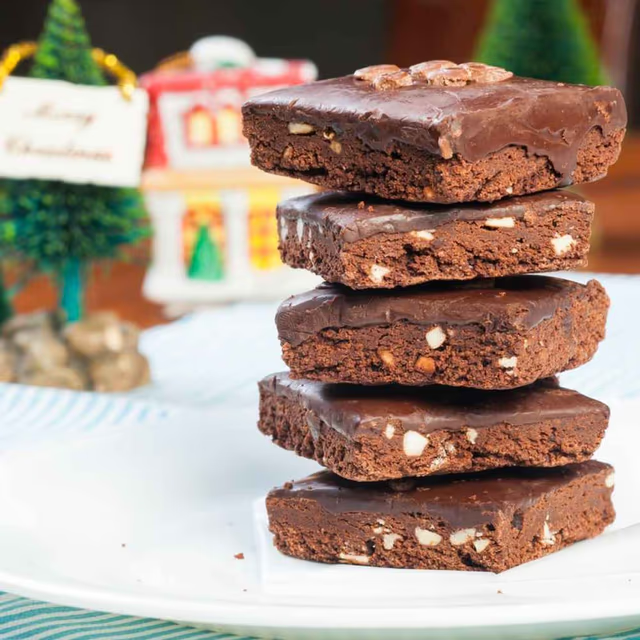
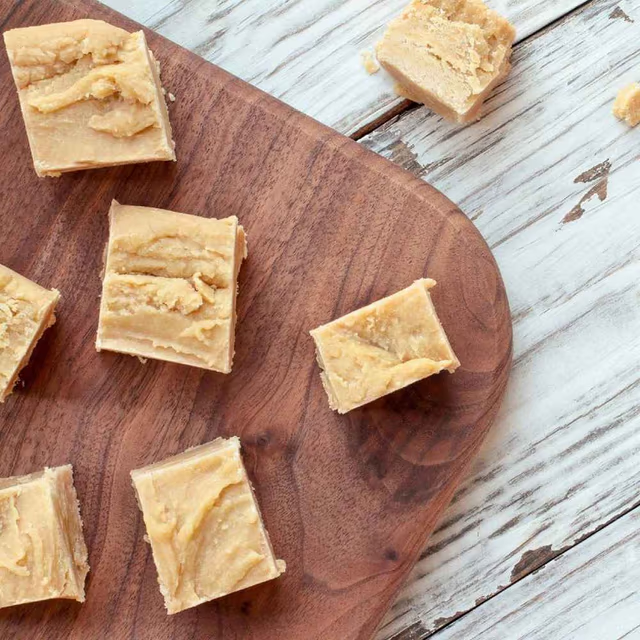
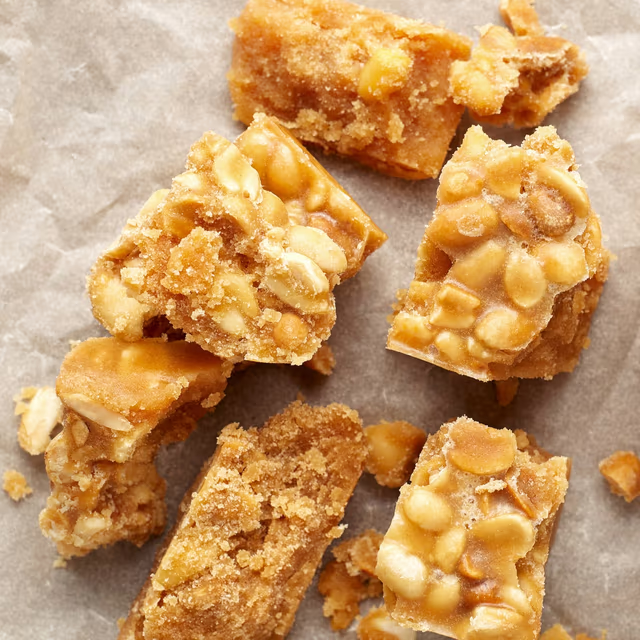
Fudge rewards patience more than skill, and the hardest part is leaving it alone while it cools. National Fudge Day is the day to make a pan, cut it into small squares, and give most of them away.

Countdown to the day
--DAYS
--HRS
--MIN
--SEC
Have an update or spot an error?
YEARLY DATEJune 16
OBSERVED INUnited States
CATEGORYFood
SUBCATEGORYCandy
ORIGIN

Community Origin

FOUNDING ENTITY
Not documented
FIRST OBSERVED
Not documented
HOW THE HOLIDAY CAME TO BE

Fudge earned a reputation long before it earned a day.

No founder or establishing record for June 16 could be located. The Federal Register carries no document under the day's name, and the name appears in no scanned volume of Chase's Calendar of Events across an index that reaches editions published from 1951 to 2007.

+ Know the story? Submit a founder Help us complete this holiday
INTRO

Fudge's origin story rests on a late recollection

The sweet at the center of National Fudge Day has become a laboratory material. In a paper posted in May 2026, a team of researchers at the University of Edinburgh cooked batch after batch of it to different final temperatures, then compressed each one in a testing machine to see how it failed.

They found two thresholds, and the two sit close together. Their samples turned from fluid to solid at 110 C, then from a solid that squashes to one that fractures at 118 C. In those batches that is the whole band between a sauce and a slab that shatters.

The candy's own history is in worse shape than its physics. The document usually cited for it is a letter written from memory, long after the events it describes, by a student who never claimed to have invented it.

Advertisement

DEALS & OFFERS

2026’s deals have wrapped

See who celebrated this year, and browse offers from past years.

ORIGINS

Fudge Day history

CHAPTER 01

What the letter actually says

The story runs that fudge was invented at Vassar College in 1888. The source is a letter from Emelyn Battersby Hartridge, class of 1892, to her old history professor Lucy Maynard Salmon. Salmon's papers at Vassar hold six letters and a card filed under Lyn Hartridge, spanning 1893 to 1924.

Hartridge claimed no invention. She wrote that fudge "was first made in Baltimore by a cousin of a school mate of mine", and sold there in a grocery store in 1886 at 40 cents a pound.

Vassar's own chronicle names that schoolmate: Nannie Hagner. What Hartridge kept for herself was smaller, and she hedged it herself: 30 pounds made for the Senior Auction, "its real introduction to the college, I think."

CHAPTER 02

The dictionary reopens the case

The Oxford English Dictionary revised its entry for fudge in June 2025 and did not find Vassar at the front of the queue. Its first unambiguous evidence for the women's college fudge craze is an Iowa newspaper of 1891. The report names a Miss Alice Doe, who had been attending Wellesley College, making fudges with a group of friends.

A cookbook printed in Oshkosh, Wisconsin carried a recipe for fudges the same year. Where the name itself came from, the dictionary will not say. Its executive editor, Peter Gilliver, wrote that on that question "there I am, to be honest, stumped", and that the answer "remains a mystery".

CHAPTER 03

An island turns it into a trade

On Mackinac Island, Michigan, the making became the attraction. Rome Murdick was the first there to work fudge on marble slabs, folding the cooling mass back with a long-handled trowel while visitors watched.

Then the smell became the advertising. Through two world wars and the Depression, Rome Murdick and his son Gould turned the kitchen cooling fans on the street, and Gould poured vanilla into a bubbling cauldron purely for the aroma it pushed outside. By the 1960s the island's visitors were being called fudgies.

TIMELINE

Timeline

Forty cents a pound in Baltimore

By Hartridge's later account, fudge was already on sale in a Baltimore grocery store at 40 cents a pound, and that is where her schoolmate's recipe came from.

Thirty pounds for the Senior Auction

Hartridge makes 30 pounds for the Vassar Senior Auction, which she called its real introduction to the college.

The first clear sighting is in Iowa

An Iowa newspaper reports a Wellesley student making fudges with friends, and a cookbook published in Oshkosh, Wisconsin carries a recipe for them.

A student writes the recipe down

A dated student letter kept in Vassar's chronicle describes fudges as a candy of sugar, chocolate, milk and a little butter.

The word settles into its modern form

The dictionary's earliest evidence of fudge as a mass noun rather than a countable one comes from a Wellesley College student magazine.

The day's name reaches print

The earliest volume carrying the day's name that could be located is Creative Forecasting, a magazine of ready-made activity calendars.

WHY THIS DAY MATTERS

Why We Love National Fudge Day

Research

A tray of fudge and a paste of calcite powder fail in the same order.

The Edinburgh preprint is not really about dessert. It uses fudge to study when a densely packed suspension stops deforming and starts breaking, and it opens on the steel of the Titanic fracturing in the unusually cold North Atlantic of April 1912, alongside the same transition in the Earth's crust. The team then reproduced the sequence in a paste of calcite powder.

Homemade

The candy you could make without a kitchen

Fudge traveled through American women's colleges as something students made themselves, after hours. Vassar's own alumnae magazine records them making it in the middle of the night, dangerously diverting the gas from their lamps for the task. The equipment was a pan and whatever heat a dormitory could be made to give up.

BY THE NUMBERS

National Fudge Day by the Numbers

61.1%
Sucrose by weight in a lab fudge recipe
Under 50 micrometers
Sugar crystal size in finished fudge
0.5 mm/s
Compression speed used to mimic chewing
10,000 lb
Mackinac Island fudge made daily in season
10 tons
Sugar shipped to Mackinac each week

MYTH VS FACT

Common Misconceptions

The myth

Fudge's invention is documented in an 1888 letter.

The truth

The letter is a recollection, not a record made at the time. The Oxford English Dictionary, describing the same account, notes that Hartridge was admittedly writing over thirty years after the event. Vassar's own chronicle and the researcher who reproduced the letter give different years for it, and neither of them is 1888.

The myth

A Vassar student invented fudge.

The truth

Vassar files that story among its myths. The college encyclopedia's Myths and Legends page records that its own Office of Media Relations calls it a fable while Historian Elizabeth Daniels says it is true, and then settles between them: Hartridge made the fudge, and attributed the recipe to a classmate's cousin.

The myth

Fudge was born on 14 February 1886, when a confectioner botched a batch of caramels.

The truth

Michael Quinion calls that a suspiciously precise date, more so because it was Valentine's Day, and reads the story as folk etymology invented long afterwards. The dictionary's editor is likewise unconvinced that the sweet is named after the verb meaning to cobble something together.

GET INVOLVED

How to Celebrate National Fudge Day

WAIT

Wait before you beat it

The recipe takes the pan off the heat, adds the butter, and tells you to beat only once the mixture has cooled a little. The Edinburgh team describe the same step in their own method, cooling each batch and then beating it to control nucleation.

GIVE

Give a box to someone who has never had it

The first fudge Emelyn Hartridge ever tasted arrived as a present. Her letter records that her brother Julian bought her the box, before she had made a batch herself.

READ

Read the letter behind the legend

Michael Quinion reproduces the first page of the Hartridge letter and transcribes the passage about Baltimore, the grocery store and the auction. It is a very different document from the one usually described.

Test your knowledge

How well do you know National Fudge Day?

1 / 7

In what year did Emelyn Hartridge say she made 30 pounds of fudge for the Vassar Senior Auction?

Answer

No. It is an unofficial food observance: the Federal Register carries no document under the day's name, against controls that return presidential proclamations for other observances, and no legal designation turned up in the indexes checked.

COLOPHON

Sources

How we know what’s on this page. References, not endorsements.

12sources
10primary records
7independently dated
Primary records
Vassar College
November 12, 1893, A Documentary Chronicle of Vassar College
The college's own dated chronicle, carrying an 1893 student manuscript letter that describes fudges and lists their ingredients, together with its account of Hartridge's letter to Professor Lucy Maynard Salmon, the named schoolmate Nannie Hagner, and the Baltimore grocery sale at 40 cents a pound.
View source
Vassar College
Vassar Myths & Legends, Vassar Encyclopedia
The college encyclopedia's page of institutional myths, which files the claim that a Vassar student invented fudge alongside legends about Jane Fonda and Edna St. Vincent Millay, records the disagreement between the Office of Media Relations and Historian Elizabeth Daniels, and states its own conclusion that Hartridge made the fudge but attributed the recipe to a classmate's cousin.
View source
Oxford English Dictionary2025-06
'fudge': Something to puzzle and to guzzle, the revision of fudge, by Peter Gilliver
The OED Executive Editor's account of the dictionary's June 2025 revision of the word, giving its first unambiguous evidence for the women's college fudge craze in an Iowa newspaper of 1891 naming a Wellesley student, an 1891 Oshkosh cookbook recipe, the earliest mass-noun evidence in an 1896 Wellesley student magazine, the description of Hartridge as writing over thirty years after the event, and the editor's conclusion that where the confection's name came from remains unresolved.
View source
Vassar College2013
Fudge Mania, Vassar, the Alumnae/i Quarterly, by Elizabeth Randolph
The alumnae magazine's correction of the invention story, its account of students making fudge at night by diverting the gas from their dormitory lamps, and a Vassar Fudge recipe of sugar, light cream, unsweetened chocolate and butter cooked to 238 F and yielding a little more than a pound.
View source
Vassar College Libraries, Archives and Special Collections2024-11
Guide to the Lucy Maynard Salmon Papers, 1818-1992 (bulk 1854-1933)
The finding aid for the professor's papers, whose correspondence series lists the folder holding the Hartridge material as six letters and a card spanning 1893 to 1924.
View source
arXiv2026-05-07
Cooking crystalline candies and the ductile to brittle transition in concentrated suspensions
A preprint by seven researchers at the University of Edinburgh that uses fudge as a model system for the ductile to brittle transition, reporting the change from fluid to solid at 110 C and from a ductile to a brittle solid at 118 C, the crystal volume fraction at each cooking temperature, and the same sequence of behavior reproduced in a calcite paste. It is a preprint rather than a peer reviewed paper, and its figures describe the authors' own recipe.
View source
arXiv2026-05-07
Cooking crystalline candies, full text
The paper's full text, carrying its opening comparison with the steel of the Titanic in the cold North Atlantic of April 1912 and with the transition in the Earth's crust, the recipe's composition at 61.1 percent sucrose by weight, the compression tests run at 0.5 mm per second to mimic slow mastication, the cooling and beating step used to control nucleation, and the scanning electron micrograph showing finished sucrose crystals of 50 micrometers or smaller.
View source
Mackinac State Historic Parks2001
Fudge: Mackinac's Sweet Souvenir, by Phil Porter
The Michigan state agency's own 40-page history of the island's fudge business, published in 2001, tracing it from the arrival of Henry Murdick in the late nineteenth century to the May family in the mid twentieth and Harry Ryba's marketing in the early 1960s.
View source
HathiTrust Digital Library
Full-text search of Chase's Calendar of Events for the day's name
A title-scoped full-text search returning no results for the day's name in any scanned Chase's volume, on an index that returns 47 volumes for Groundhog Day and 55 for New Year's Day across editions published from 1951 to 2007.
View source
Federal Register
Documents API, quoted-phrase search for the day's name
A search of the federal index returning zero documents under the day's name, run alongside controls that return 36 documents for Loyalty Day and 23 for National Small Business Week, both of them presidential proclamations.
View source
Additional coverage
FOR MARKETERS & CREATORS

Turn every day into a moment your audience actually shows up for.

8.4M
Monthly readers
5K+
Holidays tracked