
Holiday Calendar

Movie Theatre Day

Next celebratedFriday, April 23, 2027

The Vitascope reached New York in 1896 advertised as Edison's invention, though Thomas Armat and C. Francis Jenkins built it; the movie theatre's day rests on that borrowed anniversary.

Countdown to the day
--DAYS
--HRS
--MIN
--SEC
Have an update or spot an error?
YEARLY DATEApril 23
OBSERVED INUnited States
CATEGORYPop Culture
SUBCATEGORYMovies & TV
ORIGIN

Community Origin

FOUNDING ENTITY
Not documented
FIRST OBSERVED
Not documented
HOW THE HOLIDAY CAME TO BE

April 23 lands on the Vitascope's first show.

Movie Theatre Day falls on April 23, the anniversary of the Vitascope's first theatrical exhibition in 1896. No founder, sponsoring organisation or establishment record has been located, and nothing documents whether the date was chosen for that reason.

+ Know the story? Submit a founder Help us complete this holiday
INTRO

Edison's name on a projector he did not invent

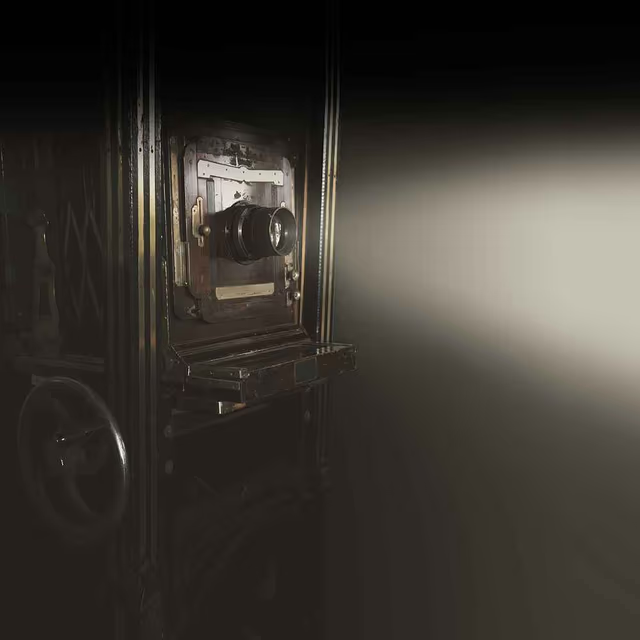
Movie Theatre Day marks the anniversary of a machine that reached American audiences under the wrong inventor's name. The Vitascope had its first theatrical exhibition in New York City on April 23, 1896. Thomas Armat and C. Francis Jenkins had built it.

Edison's company agreed to manufacture the projector and produce films for it, but only on the condition that it be advertised as a new Edison invention. The name on the machine was a term of the deal, not a record of who did the work. About seven months later the Edison Manufacturing Company brought out a projector of its own and stopped selling the Vitascope.

That is the anniversary Movie Theatre Day inherited. It is a stranger one than it looks. The date belongs to a machine, not to the first audience anywhere that ever paid to watch films on a screen.

Advertisement
ORIGINS

Movie Theatre Day history

INTRODUCTION

On May 20, 1895, a storefront on Broadway in New York opened its doors to a paying crowd. What they watched was a boxing film. The projector was the Eidoloscope, built for the Latham family, and the crowd was the world's first commercial audience for projected moving pictures.

So the calendar poses a question. The first paying audience for a projected film sat down in 1895. The anniversary the American movie theatre keeps belongs to the year after.

CHAPTER 01

What the 1896 date actually marks

The Library of Congress puts it narrowly. It calls the date the Vitascope's first theatrical exhibition, not America's first film screening. Woodville Latham's Eidoloscope had already been presented publicly in April 1895.

CHAPTER 02

Ten cents to watch, ten cents to see the projector

Three months after the Vitascope's New York debut, a storefront at 623 Canal Street in New Orleans put the machine to work full time. William T. "Pop" Rock and Walter J. Wainwright opened Vitascope Hall on July 26, 1896, with William Reed running the projector. A marker at the site calls it the first indoor seated movie theater in the United States.

Inside, 400 seated patrons watched short films on white fabric stretched across a frame for ten cents. Black canvas covered the windows. For another dime a customer could step into the booth and look at the projector itself, and demand pushed that price to fifty cents.

The machine was a commercial disappointment almost everywhere else in 1896. Of the 40 Edison Vitascope territories in the United States, only Louisiana was financially successful.

CHAPTER 03

The nickel theaters take the business

What carried movies into American life was the storefront, not the vaudeville stage. By 1906 nickel theaters were the industry's dominant exhibition outlets, running programs that lasted anywhere from ten minutes to an hour. Many changed the whole bill every day.

Movie Theatre Day arrives on that record without an author of its own. No founder, no sponsoring organization and no proclamation has been located for it, so the day rests on the anniversary it borrows. What the anniversary carries is a projector, two inventors who fell out over it, and a name that belonged to neither of them.

TIMELINE

Timeline

First paying audience for projection

A Broadway storefront showed a prizefight film on the Eidoloscope to the first commercial audience anywhere for projected moving pictures.

Vitascope debuts in New York

The Vitascope had its first theatrical exhibition at Koster and Bial's Music Hall on April 23.

Vitascope Hall opens in New Orleans

A Canal Street storefront began showing films full time on July 26, seating 400 patrons at ten cents each.

Nickel theaters dominate exhibition

Storefront nickel theaters had become the American film industry's dominant exhibition outlets, running programs of ten minutes to an hour.

Weekly attendance hits its peak

Weekly cinema attendance passed 90 million, the high-water mark for American moviegoing.

Supreme Court splits studios from theaters

United States v. Paramount led to consent decrees forcing the major studios to separate distribution from exhibition.

WHY THIS DAY MATTERS

Why Movie Theatre Day Matters

ATTENDANCE

65% of Americans went weekly in 1930. By 2000, 9.7%.

In 1930 weekly cinema attendance ran to 80 million people, about 65% of the resident US population, a higher share than any prosperous stretch since has matched. By 2000 the weekly audience had fallen to 27.3 million, or 9.7% of the country.

SPENDING

Films once took a quarter of the fun budget

Between 1942 and 1945 Americans put 23% of their total recreation spending into films. By the early 2000s that share had dropped to 2%.

LAW

Seventy years of forced separation, then none

Federal antitrust orders kept the major studios out of the theatre business until a federal court terminated the Paramount Consent Decrees in August 2020, along with their bans on block booking and circuit dealing. The decision was contested, and G. Vaughn Joy argued in ProMarket that it paved the way for major studios to overpower independent producers and exhibitors.

BY THE NUMBERS

Movie Theatre Day by the Numbers

$8.87bn
US and Canada box office, 2025 (projected)
780M
US and Canada admissions, 2025 (estimated)
31,000+
US screens the trade body represents
37,396
US movie screens in 2000

GET INVOLVED

How to Observe Movie Theatre Day

EDITOR'S PICK

Find out when your nearest cinema opened

A city landmark register or a local historical society will usually list the building's opening date. It tells you which era of the exhibition business your theatre belongs to.

READ

Read the Library of Congress account of early projection

Its essay covers the shift from peep-show machines to projectors across the 1890s and names who built what. Read it at the Library of Congress.

WATCH

Watch a film you have only ever seen at home

The same title plays differently on a large screen with a full audience. Pick something you know well so the room is the only thing that changes.

PHOTOGRAPH

Photograph your local cinema's marquee and lobby

Marquees, box offices and lobby signs change faster than the buildings behind them. A dated photograph is the kind of record local archives rarely hold.

ASK

Ask an older relative what a ticket used to cost

Ticket prices, seat counts and programme lengths changed far more than the films did. A family memory covers a stretch of that history from the inside.

Test your knowledge

How well do you know Movie Theatre Day?

1 / 8

Who actually built the projector sold as the Vitascope?

Answer

No. It is an unofficial observance with no legal standing anywhere on record, and a search of the Federal Register returns no presidential proclamation for it.

COLOPHON

Sources

How we know what’s on this page. References, not endorsements.

14sources
7primary records
10independently dated
Primary records
Additional coverage
FOR MARKETERS & CREATORS

Turn every day into a moment your audience actually shows up for.

8.4M
Monthly readers
5K+
Holidays tracked