Holiday Calendar
661 saved#53 of 6,224

Respect Your Cat Day

An unofficial observance on March 28 encouraging cat owners to recognize their cats as sentient companions and to provide attentive, respectful care.

Sunday
28
March 2027
YEARLY DATEMarch 28
OBSERVED INUnited States
CATEGORYAnimals
SUBCATEGORYCats
ORIGIN

Community Origin

FOUNDING ENTITY
Not documented
FIRST OBSERVED
Not documented
HOW THE HOLIDAY CAME TO BE

An appreciation day with no documented author.

Respect Your Cat Day has no documented founder, sponsoring organization, or first-celebration record. It has no clear online footprint before about 2014 and circulates through holiday-listing sites, pet brands, vets, and shelters rather than any single institution.

+ Know the story? Submit a founder Help us complete this holiday
INTRO

The pet on your couch may not be fully domesticated

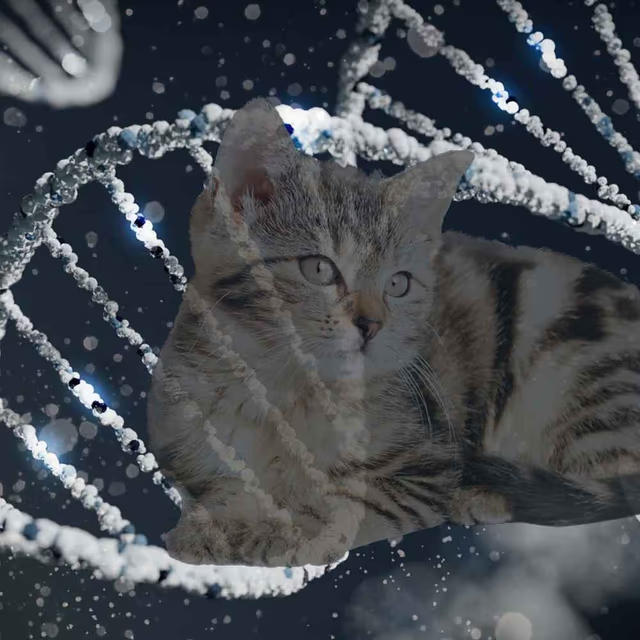
The animal asleep on your couch is not quite the tame creature the word "pet" suggests. When scientists at Washington University in St. Louis sequenced the house cat's genome in 2014, they found something odd. The genome had barely diverged from that of wild cats, and some house cats still breed with their wild relatives.

The lead researcher put it bluntly. He doubts cats are truly domesticated at all, and prefers to call them semidomesticated.

Respect Your Cat Day, observed each March 28, lands on exactly that point. The day asks owners to meet a cat on its own terms rather than a dog's, and the science gives the request some teeth. A house cat is a small predator that chose to live near people, not a companion bred over millennia to obey them.

Advertisement
ORIGINS

Respect Your Cat Day history

INTRODUCTION

The history behind Respect Your Cat Day is mostly the history of the cat itself, because the day's own origin runs out fast. There is no founder on record, no proclamation, and no clear trace of the observance online before about 2014. What the cat brings to the table is much older.

Every house cat descends from a single wild ancestor: the African wildcat, Felis lybica, a solitary hunter of North Africa and the Middle East. Its genome and the house cat's are nearly identical. The animal that curls up indoors is, genetically, almost the same animal that stalks the desert.

CHAPTER 01

From a Cyprus grave to the temples of Egypt

The earliest sign of people and cats sharing a life is a grave. Around 7500 BCE, someone on the island of Cyprus was buried beside a cat, deliberately placed at their side. Cats did not swim to Cyprus, so a person had to carry one there by boat.

Thousands of years later, ancient Egypt held cats in unusually high regard, roughly four to five thousand years ago. Yet the cat's spread was slower than the legend suggests.
CHAPTER 02

Cats reached Europe later than anyone thought

For a long time scholars assumed cats walked into Europe early. DNA says otherwise. A 2025 study in the journal Science found that fully domestic cats arrived in Europe only about 2,000 years ago, spreading out of North Africa.

Earlier "cats" found at European sites turned out to be European wildcats, a different animal. The pet most of the West takes for granted is a relatively recent arrival.

CHAPTER 03

The science that gives the day its point

The modern chapter is the one the holiday leans on. In 2014, that Washington University genome study concluded the house cat is only semidomesticated and has changed little from its wild form. The Smithsonian reached the same place, noting little separates the average house cat from its wild brethren.

That finding is the quiet argument under Respect Your Cat Day. The observance's own paper trail begins around the same time, on holiday-listing sites with no author attached, and it has spread through pet brands, vets, and shelters ever since.

WHY THIS DAY MATTERS

Why Respect Your Cat Day Matters

SCIENCE

A cat reads a hard stare as a threat, not affection.

Cats register a human's hard stare as a threat, and welfare guidance urges reading a cat's whole body rather than any single signal. The day's plea to meet a cat on its terms is grounded in how the animal actually reads the world, not sentiment.

BEHAVIOR

The bond is built on talking to us

Adult cats rarely meow at each other, so the meow a cat aims at its owner is essentially a human-directed signal it developed after moving in with people. The relationship is one the animal shaped around us, which is part of what the day asks owners to honor.

SCALE

It speaks to tens of millions of households

Cat keeping is not a niche in the United States, where roughly a third of households own at least one cat. A day about treating that animal well reaches a very large audience of people already living with the species.

BY THE NUMBERS

Respect Your Cat Day by the Numbers

42.1M
US cat households
73.8M
Pet cats nationwide
84.7%
Call cat family

GET INVOLVED

How to Observe Respect Your Cat Day

EDITOR'S PICK

Return your cat's slow blink

Catch your cat's eye, narrow your own eyes, and blink slowly while turning your head a little. The Cats Protection guidance describes this as a calm, friendly signal a cat will often return.

STOP

Stop staring at your cat

A direct, unbroken stare reads as a threat to a cat. Soften your gaze and look away now and then, especially when a cat you do not know is sizing you up.

READ

Read the whole cat, not one signal

Watch the ears, tail, posture, and eyes together rather than trusting a single cue. A purr or a flicking tail means little on its own and a lot in context.

SUPPORT

Support a shelter or rescue

Mark the day by donating to or volunteering with a local cat shelter. Many run on thin budgets and welcome food, supplies, or an afternoon of socializing cats waiting for homes.

LEARN

Learn how your cat actually thinks

Read up on cat genetics and behavior from a veterinary or science source rather than folklore. Understanding that a cat is a near-wild predator changes how you set up its home and your expectations.

Test your knowledge

How well do you know Respect Your Cat Day?

1 / 6

What did a 2014 Washington University genome study conclude about house cats?

Answer

It falls on March 28 every year. It is a US-centric observance that spreads mainly through holiday-listing sites, pet brands, vets, and shelters.

FOR MARKETERS & CREATORS

Turn every day into a moment your audience actually shows up for.

8.4M
Monthly readers
5K+
Holidays tracked