Holiday Calendar
399 saved#250 of 6,224

National Hairstylist Appreciation Day

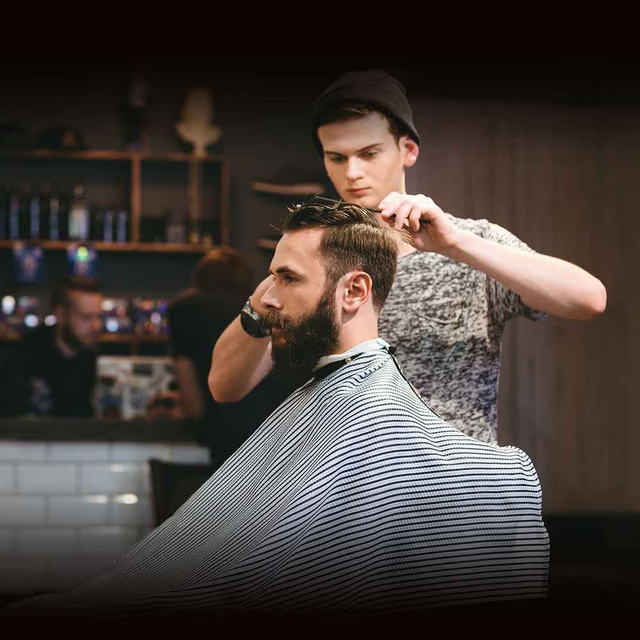
A careers observance on April 25 recognizing the skill, training, and personal role of hairstylists and the licensed beauty profession.

Sunday
25
April 2027
YEARLY DATEApril 25
OBSERVED INUnited States
CATEGORYCareers
SUBCATEGORYCreatives
ORIGIN

Community Origin

FOUNDING ENTITY
Not documented
FIRST OBSERVED
2012
HOW THE HOLIDAY CAME TO BE

An industry thank-you with no named author.

National Hairstylist Appreciation Day emerged from within the beauty industry and has been observed since at least 2012. No single founder or formal establishment record has been identified.

+ Know the story? Submit a founder Help us complete this holiday
INTRO

The license that outlasts an EMT's, by ten months

Becoming a licensed cosmetologist takes longer than becoming the person who shows up in the ambulance. The Institute for Justice found that across the states, a cosmetology license requires about 342 days of training on average, against roughly 36 days for an emergency medical technician.

The same study counted 71 lower-income occupations that demand more training than an EMT. Cosmetology sat near the top of that list. National Hairstylist Appreciation Day, observed on April 25, points at the gap between how much a stylist has to learn and how lightly the job is usually regarded.

The hours behind the chair are not just scissors work. State programs cover chemistry, skin and scalp analysis, and the sanitation rules that keep a salon from passing infections from one client to the next.

Advertisement
ORIGINS

Hairstylist Appreciation Day history

INTRODUCTION

A haircut looks simple from the chair. The license behind it is not. Every US state requires barbers, hairstylists, and cosmetologists to be licensed, and the path runs through a state-approved program and a board exam before anyone is allowed to color, perm, or even shampoo for pay.

The Bureau of Labor Statistics lists what that training is for. Stylists inspect and analyze hair, scalp, and skin, chemically change hair texture, and disinfect every tool and surface they touch. The chemistry and the sanitation are the reason the schooling runs into four figures of hours.

CHAPTER 01

How a haircut became a licensed trade

The rules did not always exist. In 1897, Minnesota passed the first barber-licensing law in the country, pushed by the Journeymen Barbers' International Union to set sanitation standards and close unsafe shops. Within five years, more than 2,500 Minnesota barbers held licenses.

Other states copied the model over the next forty years and widened it to cosmetology. A trade that had been learned by watching turned into one gated by hours, exams, and a state board.
CHAPTER 02

What the license costs now

The hours kept climbing. A century of state rule-making turned a watched-and-learned trade into one that demands a thousand-plus classroom hours and several thousand dollars of tuition before a graduate has earned a cent. Sanitation and chemistry, not just styling, fill those hours.

CHAPTER 03

The day itself

National Hairstylist Appreciation Day arrived with none of that paperwork. It has circulated within the beauty industry since at least 2012, with no founder or establishing document on record. The day is young and undocumented; the profession it honors is neither.

WHY THIS DAY MATTERS

Why National Hairstylist Appreciation Day Matters

TRUST

People tell their stylist things they tell almost no one else.

Research describes hairdressers and barbers acting as informal mental-health gatekeepers, with salons functioning as spaces of steady, nonjudgmental listening. The role is real enough that training programs now exist to support it, including a micro-counseling certification launched in 2019.

OWNERSHIP

It is one of the country's broadest small-business bases

A large share of stylists work for themselves, renting a chair or running their own salon across more than a million businesses nationwide. Many a stylist is also a bookkeeper, marketer, and sole proprietor between appointments.

RECOGNITION

The training rarely shows up in the paycheck

Median pay for hairstylists sits below many trades that ask for far less schooling. A day of recognition is a small correction to that gap between what the job demands and what it returns.

BY THE NUMBERS

National Hairstylist Appreciation Day by the Numbers

651,200
US jobs, 2024
$60.6B
Hair-salon industry
~91%
Of stylists are women
5%
Job growth, 2024-2034

AT A GLANCE

The cosmetology profession at a glance

License
Required in all 50 states
Training
At least 1,000 hours, often around 1,500
School cost
About $16,000 on average
Median pay
$16.95 per hour for hairstylists (May 2024)
Entry path
State-approved program, then a board exam

GET INVOLVED

How to Observe National Hairstylist Appreciation Day

EDITOR'S PICK

Tip beyond your usual amount

Many stylists are self-employed and rely on tips for a real share of their income. Marking the day with a larger-than-normal tip is the most direct form of recognition.

WRITE

Write a specific, named review

Online reviews shape whether a stylist keeps a chair full. Post a detailed review that names what they did well, since it costs nothing and directly affects their bookings.

LEARN

Learn what the license actually requires

Read the Bureau of Labor Statistics overview to see the training, exams, and chemistry behind a routine appointment. The context tends to change how people regard the work.

REFER

Refer someone you trust

Word-of-mouth remains the strongest marketing a stylist has, especially an independent one. Sending a friend their way is a quiet but meaningful thank-you.

RECOGNIZE

Recognize a stylist who has stuck with you

Many people see the same stylist for years and share more than small talk. A short note acknowledging that steadiness honors the part of the job that has nothing to do with scissors.

Test your knowledge

How well do you know National Hairstylist Appreciation Day?

1 / 6

According to the Institute for Justice, how does cosmetology training compare with EMT training?

Answer

It is observed on April 25 each year in the United States.

FOR MARKETERS & CREATORS

Turn every day into a moment your audience actually shows up for.

8.4M
Monthly readers
5K+
Holidays tracked