Holiday Calendar

Flower Day

Next celebratedThursday, May 20, 2027

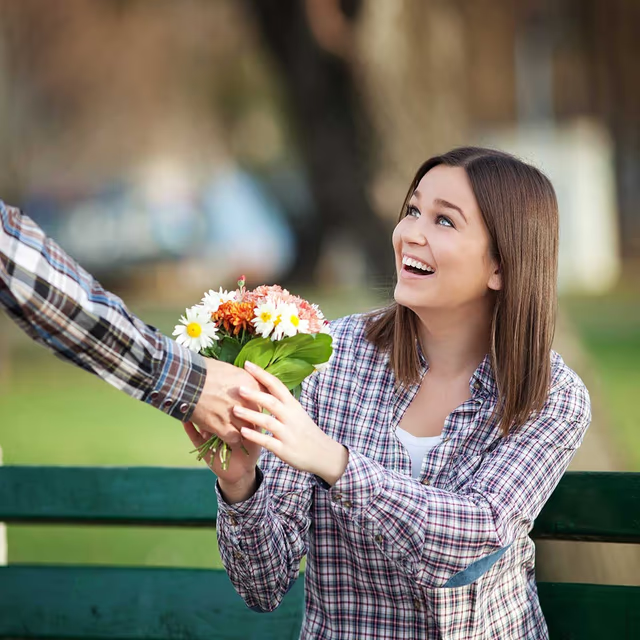
An informal annual observance on May 20 that celebrates flowers, the plants that produce them, and the people who grow and sell them.

Countdown to the day
--DAYS
--HRS
--MIN
--SEC
Last updated February 7, 2026 · by the Holiday Calendar TeamHave an update or spot an error?
YEARLY DATEMay 20
OBSERVED INInternationally
CATEGORYNature
SUBCATEGORYPlants
ORIGIN

Community Origin

FOUNDING ENTITY
Not documented
FIRST OBSERVED
Not documented
HOW THE HOLIDAY CAME TO BE

An appreciation day with no paper trail

No founder, organization, proclamation, or campaign for the May 20 Flower Day has been documented. The day circulates through holiday listings and social posts as a general appreciation of flowers, and there is no sourced explanation for why it lands on May 20.

+ Know the story? Submit a founder Help us complete this holiday
INTRO

The secret flower code that nobody could agree on

For most of the 1800s, a bouquet was supposed to be a sentence. A red rose said love, a yellow one hinted at jealousy, and a posy handed over the right way could carry a message too delicate to say aloud. The trouble is that nobody could agree on the words.

The Victorian language of flowers was never standardized. Rival dictionaries gave the same bloom opposite meanings, so the message a sender encoded depended entirely on which book the recipient happened to own. It was less a secret language than a publishing fad, with new flower-meaning guides arriving as fashionable gifts that quietly contradicted one another on the shelf.

That tangle is a fitting hook for Flower Day, observed each May 20. The day itself has no documented founder and no recorded reason for its date. What it does have is a subject worth the attention: a piece of plant biology, a global supply chain, and a few flowers strange enough to smell of death.

Advertisement
ORIGINS

Flower Day history

CHAPTER 01

A language assembled from imagination

The idea that flowers could speak reached Europe through Lady Mary Wortley Montagu, who described Turkish flower-message customs after living at the Ottoman court in Constantinople around 1717. Her letters seeded a fascination that would bloom a century later.

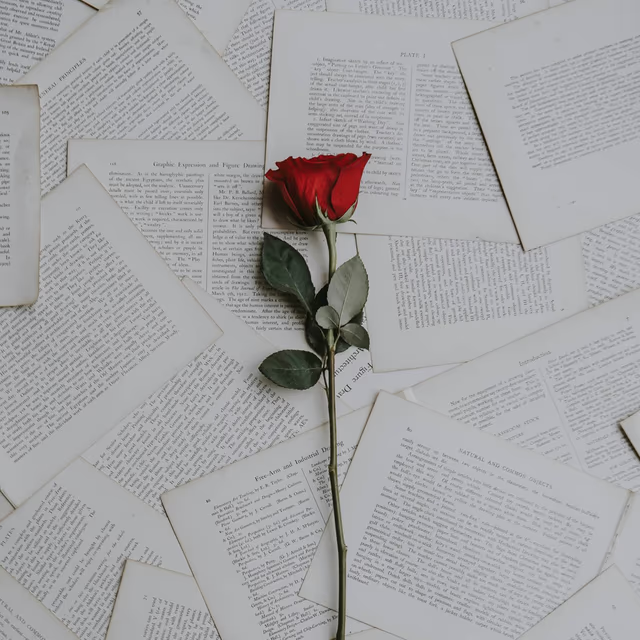
The first real reference book came in 1819, when Louise Cortambert, writing as Madame Charlotte de la Tour, published Le langage des Fleurs, the first dictionary of floriography. An earlier 1809 list by Joseph Hammer-Purgstall had catalogued meanings, but Cortambert's book set the template. By mid-century the genre had become a fixture of Victorian bookshelves, and Victorians traded small bouquets called nosegays or tussie-mussies as wearable notes.
CHAPTER 02

What a flower is actually for

Strip away the romance and a flower is a working organ: a plant's reproductive structure, built to move pollen from male parts to female ones and make seed. Its color, scent, and shape are not decoration for human eyes but advertising aimed at pollinators, tuned over millions of years to the insects and birds that visit.

That partnership runs most of the botanical world, and it deepens toward the equator. A landmark 2011 study found that the share of plants relying on animal pollinators climbs from about 78 percent in temperate communities to 94 percent in the tropics. A flower in a rainforest is even more dependent on its visitor than one in a meadow.

CHAPTER 03

From a Dutch town to your kitchen table

The flowers most people actually buy travel a long way to reach them. More than half of all cut flowers sold worldwide pass through one Dutch town, Aalsmeer, home to the Royal FloraHolland auction, the largest place flowers are traded anywhere. Much of that stock is grown near the equator and flown in overnight from Kenya, Ethiopia, Ecuador, and Colombia.

CHAPTER 04

A day without a maker

Flower Day sits on top of all that as a simple appreciation of flowers, with one honest caveat. No founder, organization, or proclamation for the May 20 date has been documented, and aggregator listings that promote the day concede they cannot explain why it falls on the 20th. It is best understood as a community-grown observance, carried by social posts and florist marketing rather than any single creator.

WHY THIS DAY MATTERS

Why We Love Flower Day

Ecology

A flower is a plant's pitch to an animal, and most of the plant kingdom is making it.

Flowers are the front line of a partnership that keeps ecosystems running. Because about 87.5 percent of flowering-plant species rely on animal pollinators, the health of bees, birds, and beetles is tied directly to whether those plants set seed at all.

Economy

Pollination is worth billions

The same animals that visit flowers underpin the food supply. Researchers have put the value of animal pollination to the world's leading food crops at about 153 billion euros a year, roughly a tenth of global agricultural output.

Commerce

A bouquet is a global supply chain

The flower in a supermarket bunch is often the end of an overnight flight. Stems cut on equatorial farms in Kenya or the Andes can reach the Dutch auctions and then a shelf across the world within days, a race against wilting that makes flowers one of the most time-sensitive goods in global trade.

BY THE NUMBERS

Flower Day by the Numbers

87.5%
Flowering plants pollinated by animals
45.4%
Netherlands share of global flower exports
$835M
Kenya flower export earnings in 2024

TIMELINE

Timeline

Montagu meets the language of flowers

Lady Mary Wortley Montagu describes Turkish flower-message customs from the Ottoman court, seeding Europe's later fascination.

The first published list of meanings

Joseph Hammer-Purgstall issues an early catalogue of flower meanings, a precursor to the dictionaries to come.

The first floriography dictionary

Louise Cortambert, as Madame Charlotte de la Tour, publishes Le langage des Fleurs and launches a Victorian publishing fad.

Counting the pollinated world

Researchers publish the first systematic global estimate of how many flowering plants depend on animal pollinators, putting the figure in the high majority.

A record-breaking corpse flower

A titan arum at Meise Botanic Garden reaches 3.225 meters, a documented record for the world's largest unbranched inflorescence.

GOOD TO KNOW

Surprising facts about Flower Day

The world's largest flower is a parasite

Rafflesia arnoldii of the Borneo and Sumatra rainforests grows up to a meter wide but has no leaves, stems, or roots. It lives as threads inside a jungle vine and smells of rotting meat to lure carrion flies, and almost no botanic garden, including Kew, can cultivate it.

The corpse flower heats itself

The titan arum warms its bloom to about 32 degrees Celsius for a single evening, helping push out a stench of rotting flesh to attract carrion beetles. It can take a decade to store enough energy for one short-lived flowering.

Victorians wore their bouquets

Small posies called nosegays or tussie-mussies were carried or pinned as fashion accessories, partly to mask the smell of city streets. The word nosegay comes from flowers smelling nice, with gay meaning ornament.

One auction sells 20 million flowers a day

On a typical day the Royal FloraHolland auction at Aalsmeer trades roughly 20 million cut flowers, most of them sold and shipped within hours of changing hands.

GOOD TO KNOW

Flower Day Around the World

Netherlands

A small country with little equatorial sun still tops the trade, exporting 45.4 percent of the world's cut flowers in 2024 by importing blooms from Africa and the Andes and re-selling them on.

Kenya

A leading grower of cut flowers, the industry earned about 835 million dollars in exports in 2024, with the European Union its largest market.

Ecuador and Colombia

Andean farms supply much of the world's roses and bouquets, feeding the Dutch auctions and markets across the Americas.

Detroit, United States

Eastern Market's separate Flower Day, founded in 1967, fills the city with growers on the first Sunday after Mother's Day, not on May 20.

MYTH VS FACT

Common Misconceptions

The myth

The Victorian language of flowers was a fixed, agreed code.

The truth

It was never standardized. Different dictionaries gave the same flower different meanings, so a bouquet's message changed depending on which book each person owned.

The myth

The corpse flower is the world's largest flower.

The truth

The titan arum, often called the corpse flower, is the largest unbranched inflorescence, a cluster of many flowers. The largest single flower is Rafflesia arnoldii, up to a meter across.

The myth

Flower Day on May 20 is the famous Detroit Flower Day.

The truth

Detroit's Eastern Market Flower Day is a separate event, founded in 1967 and held on the first Sunday after Mother's Day, a floating date that does not land on May 20.

GET INVOLVED

How to Celebrate Flower Day

EDITOR'S PICK

Learn what a flower is doing

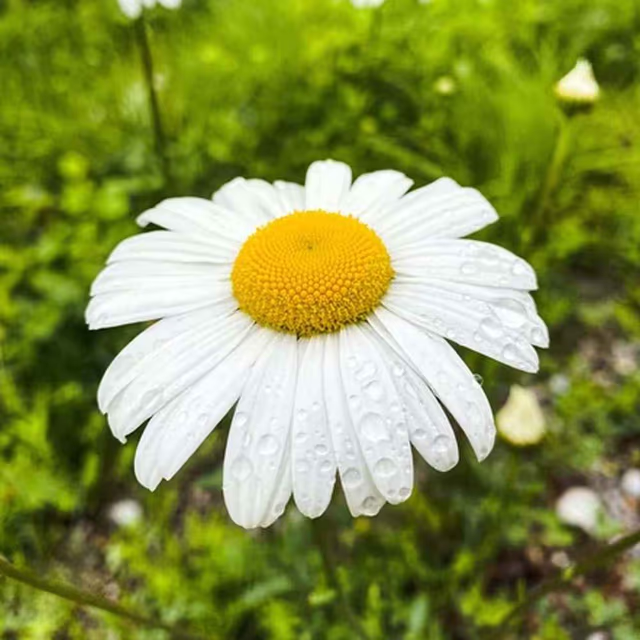
Look closely at a single bloom and find its working parts, the stamen and the pistil. Seeing a flower as a plant's pitch to a pollinator changes how you read a garden.

PLANT

Plant for pollinators

Add nectar-rich flowers to a yard, balcony, or windowsill to support the bees, birds, and beetles that most flowering plants depend on. A small patch counts.

BUY

Buy from a local grower

Visit a neighborhood florist or farmers market and ask where the stems came from. It is a quiet way to appreciate the long supply chain behind a bouquet.

SEND

Send a deliberate bouquet

Borrow the Victorian idea and choose flowers for what they mean to you and the recipient, with the freedom of knowing there was never one official code.

GO

Go see a strange one

Many botanic gardens grow oddities like the titan arum and announce rare blooms. Catching one in flower, smell and all, is a memorable way to mark the day.

Test your knowledge

How well do you know Flower Day?

1 / 8

What was the biggest flaw in the Victorian language of flowers?

Answer

No. It is an informal, unofficial observance, so banks, schools, and offices stay open as normal.

COLOPHON

Sources

How we know what’s on this page. References, not endorsements.

10sources
2primary records
4independently dated
Primary records
Additional coverage
Royal Botanic Gardens, Kew
Rafflesia arnoldi
Botanic authority describing Rafflesia arnoldii as the world's largest single flower, up to a meter across, a leafless and rootless parasite that smells of rotting meat.
View source
National Geographic2026-02-12
Inside the world's largest flower market
Reporting on Royal FloraHolland at Aalsmeer as the world's largest flower auction, selling about 20 million flowers a day and trading more than half the world's cut flowers.
View source
Floriculture (Kenya)2024
Kenya's Flower Exports Reached $835 Million in 2024
Trade-press report, citing the Kenya Flower Council, that Kenya's flower industry earned about 835 million dollars in 2024 exports, with the European Union its largest market.
View source
Wikipedia
Language of flowers
Background on floriography, including Montagu's role around 1717, Cortambert's 1819 first dictionary, the lack of any standardized meanings, and tussie-mussies.
View source
The Curious Rambler
The Secret Victorian Language of Flowers
Account confirming the language of flowers was never standardized, that different dictionaries gave the same flower different meanings, and that the books were fashionable gifts.
View source
Library of Congress
What is the largest flower in the world?
Reference explainer distinguishing the largest single flower (Rafflesia) from the largest unbranched inflorescence (the titan arum).
View source
Wikipedia
Amorphophallus titanum
Profile of the titan arum, the world's largest unbranched inflorescence, including its rare blooming, self-heating to about 32 degrees Celsius, and the 3.225-meter record at Meise in 2024.
View source
Eastern Market Flower Day
Flower Day
Event page for Detroit's Eastern Market Flower Day, founded in 1967 and held on the first Sunday after Mother's Day, used here only to distinguish it from the May 20 observance.
View source
FOR MARKETERS & CREATORS

Turn every day into a moment your audience actually shows up for.

8.4M
Monthly readers
5K+
Holidays tracked