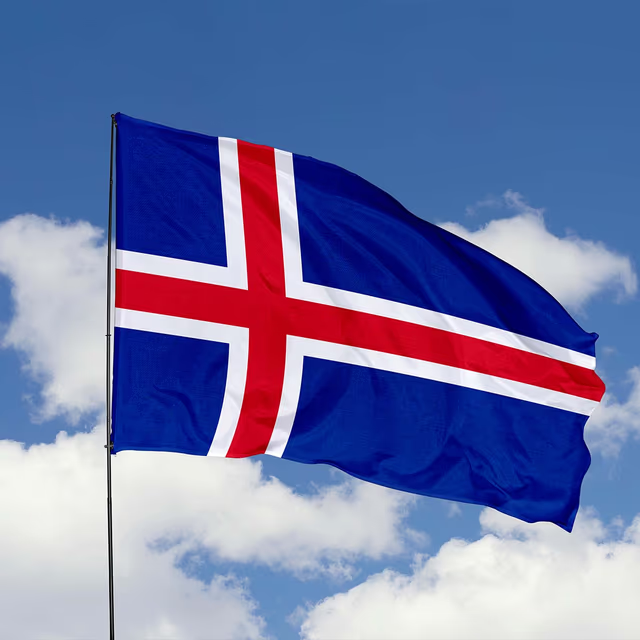
Holiday Calendar
Your holidays

Commerce Day

Next celebratedMonday, August 2, 2027

Iceland's shop and office workers are the reason the country has a holiday on the first Monday in August, and under their own collective agreement they remain the ones paid at the top holiday rate for working it.

Countdown to the day
--DAYS
--HRS
--MIN
--SEC
Have an update or spot an error?
YEARLY DATEFirst Monday in August
OBSERVED INIceland
CATEGORYBusiness
SUBCATEGORYEntrepreneurship
ORIGIN

Institutional Initiative

FOUNDING ENTITY
Verzlunarmannafélag Reykjavíkur
FIRST OBSERVED
1894
HOW THE HOLIDAY CAME TO BE

A day the shop owners handed over themselves.

Frídagur verslunarmanna was first held on Thursday 13 September 1894, after a members' meeting of Verzlunarmannafélag Reykjavíkur heard that the merchants and store managers of the larger Reykjavík shops had offered to give their staff a day off. The association then organised the day itself to make sure it was used as intended.

INTRO

Named for shop workers by everyone except the law

In Icelandic, Commerce Day is frídagur verslunarmanna, the commerce workers' day. The union says so, both sides of the labour market say so, and so does the University of Iceland. The law that grants the holiday does not.

Article 6 of Iceland's Act on the 40-hour working week hands the country a paid day off without naming a trade. About this Monday it says one thing: that the first Monday in August shall be a holiday. The bill that inserted that sentence in 1982 runs to two articles, and the word verslunarmanna appears in neither.

The day reached the statute book as small change. It was one half of a pair of measures the government valued at a little over two percent of pay for the workers who had the least entitlement. Both were brought in to offset a cut in wage indexation due that December.

Advertisement
ORIGINS

Commerce Day history

INTRODUCTION

Iceland held its first national festival in the summer of 1874. The occasion was the thousandth anniversary of settlement and a visit from King Christian IX, who arrived carrying a constitution for Iceland's own affairs. Reykjavík marked it on 2 August.

The date outlived the festival. After fullveldisdagurinn, the sovereignty day, took over as the country's chief national commemoration from around 1918, the shop workers kept the old summer date going when almost everyone else had let it drop.

CHAPTER 01

A club with the bosses inside it

Verzlunarmannafélag Reykjavíkur was founded on 27 January 1891, and it was not a union. Wage earners and employers in the retail trade sat in it together.

So when the owners of the larger shops offered their staff a day off, they were making the offer inside their own association. The clerks gathered at Lækjartorg before noon, walked out to Ártún under banners and to the blare of horns, and did not set off home until seven.

CHAPTER 02

The date that stopped moving

For years the holiday drifted. It fell in mid September, then mid August, then late August. By 1918 the shop workers were meeting at Vatnaskógur on 2 August, the date of the old national festival.

In the early 1930s it settled on the first Monday in August and has not moved since. The union ties the choice to a change in the rules on shop closing times, while the cultural historian Árni Björnsson dates the decision to the winter of 1933 to 1934.

CHAPTER 03

Everyone was already out of town

By 1941 the problem had reversed. The union won airtime on the state broadcaster that year and put its holiday programme out on the Tuesday, on the view that shop workers would all be outside in the good weather or travelling.

CHAPTER 04

The law arrives 89 years late

The association changed before the statute did. On 28 February 1955 the employers agreed to withdraw, and what had been a joint trade body became a union of workers alone.

The holiday itself was formalised last, and inside an economic package rather than on its own merits. Alþingi passed the amendment in 1982, and from 1983 the first Monday in August was a paid statutory holiday.

TIMELINE

Timeline

Iceland's first national festival

Reykjavík marked the millennium of settlement on 2 August, and the early August slot the holiday still occupies descends from it.

A trade body with both sides in it

Verzlunarmannafélag Reykjavíkur was founded in Reykjavík by retail wage earners and their employers together.

The first day off

Reykjavík's shop workers walked out to Ártún by the Elliðaár river on 13 September for speeches, races and dancing.

A holiday broadcast on Tuesday

The union won airtime on the state broadcaster but scheduled the programme a day late, assuming its members would be away.

The employers walk out

Retail employers agreed to withdraw from the association that had created the holiday, which became a union of workers alone.

The Monday becomes law

An amendment passed the previous year made the first Monday in August a paid statutory holiday across Iceland.

BY THE NUMBERS

Commerce Day by the Numbers

Up to 5,000
People at the 1935 Þingvellir gathering
~36,000
Estimated crowd, eight 1967 festivals
197,221
Iceland's population, 1 January 1967
1.84%
Pay value of the 1982 leave extension

GOOD TO KNOW

Where the day was actually held

Eiði in Gufunes, 1937 to 1939

The union built a football pitch on the gathering ground there, and put wholesalers up against retailers and their staff.

Hótel Borg, the first post-war years

In the first years after the war the union held its celebration indoors, as a ball at the Reykjavík hotel.

Tívolí, 1947 to 1957

Outdoor gatherings resumed at the amusement park and stayed there for a decade before the union's family events paused for years.

The Family Park and Zoo, 1996 to 2005

The union revived its family festival there, then wound it up and redirected the money into its members' contingency fund.

Herjólfsdalur, Westman Islands

The valley festival has run almost every year since 1901, missing only the war years of 1914 and 1915.

All the townspeople who are able have flocked into the Valley to forget for a while the toil for their daily bread.
Árni GuðmundssonWriting in 1931 about the Westman Islands festival, translated from Icelandic
outrageous drunkenness and hooliganism
Morgunblaðið and VísirIcelandic newspapers of 5 August 1952, translated from Icelandic

WHY THIS DAY MATTERS

Why Commerce Day Matters

PROTECTION

The holiday came first. The safety net took 73 more years.

Reykjavík's shop workers had a holiday of their own from 1894, but they did not reach the unemployment insurance fund on the same terms as other workers in the labour confederation until 1 January 1967. It took a general strike call in March 1966 to get there.

WAGES

One trade is singled out for the higher rate

The employers' confederation files the first Monday in August among Iceland's general holidays rather than its major ones, then records the special provision in the shop and office workers' agreement that lifts it to the top tier for them. Anyone covered by that agreement who works the Monday is paid at the major-holiday rate.

CALENDAR

The last long weekend of the Icelandic year

On the employers' confederation's list of Iceland's general holidays, the first Monday in August is the last one before Boxing Day. That gap is part of why the union that created the day now calls the weekend around it one of the biggest travel weekends of the year.

GET INVOLVED

How to Observe Commerce Day

EDITOR'S PICK

Read the two-article law that created it

The whole amendment fits on a single page and its explanatory note is one sentence long. The consolidated text sits in Article 6 of the 40-hour working week Act.

CHECK

Check opening hours before the Monday

Some Icelandic shops, banks and public offices close or run reduced hours on the day. Confirm anything you actually need in advance rather than on the morning.

LOOK

Look up how the day is paid where you work

Iceland sorts its holidays into two pay tiers, and this one sits differently depending on the agreement covering you. The employers' confederation lists both tiers side by side.

FOLLOW

Follow the Westman Islands festival

Þjóðhátíð runs in Herjólfsdalur across the days before the holiday Monday, and its organisers publish the programme each year. The organisers publish their own history of it alongside the practical details.

THANK

Thank whoever is behind the counter

The holiday exists because shop staff were once given a day away from the counter, and Iceland still keeps pay rules for those who work it. A word to the person serving you costs nothing and lands on the point of the day.

Test your knowledge

How well do you know Commerce Day?

1 / 8

What does the Icelandic statute actually call the holiday?

Answer

Yes. The first Monday in August has been a paid statutory holiday since 1983 under Article 6 of the Act on the 40-hour working week, though it is not one of the National Church's holy days.

COLOPHON

Sources

How we know what’s on this page. References, not endorsements.

12sources
11primary records
6independently dated
Primary records
AlþingiConsolidated 20 April 2026
88/1971: Lög um 40 stunda vinnuviku
The consolidated Icelandic statute on the 40-hour working week. Article 6 lists the country's general holidays and, in a paragraph added in 1982, provides that from 1983 the first Monday in August shall be a holiday paid under the same collective-agreement rules as other general holidays. The trade the day is named for appears nowhere in the text.
View source
Alþingi1982
Þingskjal 57, 56. mál: frumvarp til laga um breyting á lögum um 40 stunda vinnuviku
The complete 1982 bill that created the statutory holiday, laid before the 105th legislative session. It runs to two articles and its explanatory memorandum is a single sentence referring the reader to the companion bill on holiday entitlement.
View source
Alþingi1982
Þingskjal 56, 55. mál: frumvarp til laga um breyting á lögum um orlof
The companion bill whose memorandum supplies the reasoning for both measures: the government's August 1982 declaration on economic measures, the offsetting of a cut in wage indexation due on 1 December, the valuation of the holiday extension at 1.84 percent of pay, and the statement that the lowest-entitlement workers had no paid leave on the day before the change.
View source
VR stéttarfélag
Frídagur verslunarmanna
The founding association's own account of the day it created, based on Lýður Björnsson's history of Verzlunarmannafélag Reykjavíkur. Covers the first observance on 13 September 1894, the march from Lækjartorg to Ártún, the shifting early dates, the move to Þingvellir in 1935, the wartime gap and the 1941 Tuesday broadcast, and the day's status as a major holiday under the union's collective agreements.
View source
VR stéttarfélag
Saga VR
The union's institutional history. Records the association's founding on 27 January 1891 jointly by retail employees and employers, the employers' withdrawal on 28 February 1955, and the 1966 strike call that won shop and office workers unemployment insurance on equal terms from 1 January 1967.
View source
Alþýðusamband Íslands
Aukafrídagar skv. lögum um 40 stunda vinnuviku
The Icelandic Confederation of Labour's statement of the day's legal history, which records that shop workers first celebrated it in the later 19th century and that it did not become a statutory holiday until 1983.
View source
Samtök atvinnulífsins
Sérstakir frídagar, rauðir dagar
The Confederation of Icelandic Enterprise's guide to holiday pay. Lists Iceland's general holidays and its major holidays as two separate sets, places the first Monday in August in the first, and records the special provision in the shop and office workers' collective agreement that makes it a major holiday for them.
View source
ÍBV2019
Þjóðhátíð, Sagan
The organisers' own history of the Westman Islands festival held on this weekend. Records its first holding in Herjólfsdalur in 1874, its annual run since 1901 apart from 1914 and 1915, the handover to ÍBV in 1997, and a period passage written in 1931 by Árni Guðmundsson.
View source
Hagstofa ÍslandsSeries to 2026
Lykiltölur mannfjöldans 1703-2026
Statistics Iceland's key population series, giving the population on 1 January for every year. Supplies the figures that give the historical crowd counts their scale, including 197,221 residents in 1967.
View source
Citizens Information
Public holidays
Ireland's official public information service, listing the first Monday in August among the country's public holidays and giving the corresponding dates.
View source
GOV.UK
UK bank holidays
The official UK bank holiday tables, which show Scotland's summer bank holiday falling on the first Monday in August while England, Wales and Northern Ireland take the last Monday.
View source
Additional coverage
FOR MARKETERS & CREATORS

Turn every day into a moment your audience actually shows up for.

8.4M
Monthly readers
5K+
Holidays tracked