Holiday Calendar
Your holidays

National Pickle Day

Next celebratedSaturday, November 14, 2026

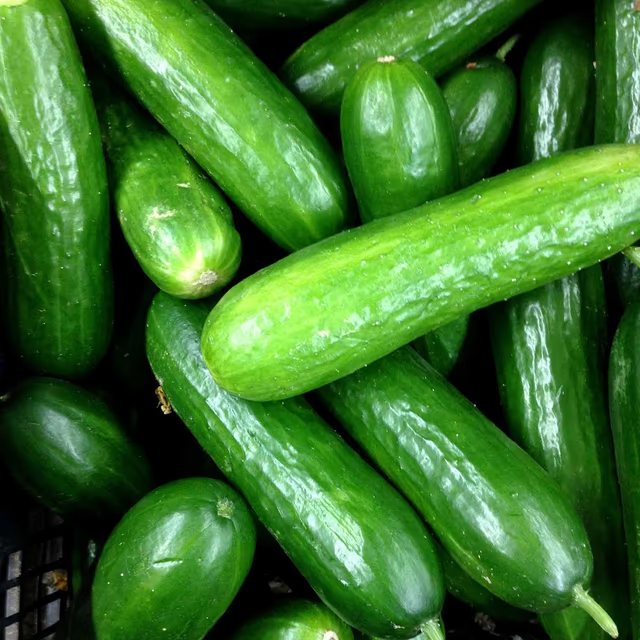
A pickle is a cucumber that spent a while getting interesting, and National Pickle Day is a fine reason to go and eat one. Open a jar at lunch and set a spear beside something rich on the plate.

Countdown to the day
--DAYS
--HRS
--MIN
--SEC
Have an update or spot an error?
YEARLY DATENovember 14
OBSERVED INUnited States
CATEGORYFood
SUBCATEGORYSide Dishes
ORIGIN

Community Origin

FOUNDING ENTITY
Not documented
FIRST OBSERVED
Not documented
HOW THE HOLIDAY CAME TO BE

The trade association's calendar holds a week, not a day.

The record names no author. Nothing was located establishing a pickle day on 14 November, while the American pickle industry's own trade association dates its first National Pickle Week to 20 to 28 May 1949 and lists no pickle day at all.

Read the packers' own historyvia Pickle Packers International
INTRO

Some pickles get their sour from bacteria

Ask the federal government what a pickle is and the answer comes back as a question about acid. The Food and Drug Administration's rule on acidified foods names beans, cucumbers, cabbage, artichokes, cauliflower, puddings, peppers, tropical fruits and fish, then says those foods may be called, or may purport to be, "pickles" or "pickled ______."

That rule is about food made sour by having acid added to it. The barrel dill is not that. A cucumber held in salt brine for a week or more sours itself, and FDA's own inspection program states that naturally fermented products are not considered acidified foods.

USDA draws its line somewhere else again. Its grade standard says pickles are prepared "entirely or predominantly from cucumbers" and preserved "through natural or controlled fermentation or by direct addition of vinegar". One word, two agencies, and a snack that is really two foods wearing the same label.

Advertisement

DEALS & OFFERS

2026 ran without a deal

No tracked offers this year. Here’s who has celebrated in past years.

ORIGINS

Pickle Day history

CHAPTER 01

The trade that filled the pushcarts

In February 1905 the mayor of New York appointed a commission to find out what was happening on his streets. Its census counted 4,515 push-cart peddlers across the city, 3,848 of them in Manhattan, and 2,362 of those crowded onto the east side below Fourteenth Street, east of Broadway.

The commission asked what every cart was selling and printed the answer as a table. Pickles never got a line of their own. They went into what the report called a miscellaneous class, filed alongside bread, cakes, cheese, ice cream, olives, peanuts and seltzer water.

The peddlers themselves were counted far more carefully. In Manhattan, three groups the report named as Hebrew, Italian and Greek made up over 97 per cent of them, and Americans numbered 62, or 1.61 per cent. The commission objected that the licence was printed "solely in the English language" and asked for it in several languages, Yiddish and Greek among them.

Curb space was worth real money. A statement the report prints from Sigmund Schwartz, president of the United Citizens' Peddlers' Association, describes a druggist at Rivington and Orchard streets renting out the pavement in front of his shop: a soda water stand at $25 a month, a boot-black at $20, and a pickle stand at $35, the highest rent of any single stand on the list.

CHAPTER 02

The industry gets a calendar

While the carts were being counted, the people supplying them were already organised. The National Pickle Packers Association had been founded in 1893 as a promotional agency, and it incorporated in Illinois on 14 December 1933.

Its first National Pickle Week ran from 20 to 28 May 1949. The association renamed itself Pickle Packers International on 9 December 1963, and the week survives, now a ten-day run built around the Memorial Day weekend.

What that calendar does not carry is 14 November. No founder, no first observance and no establishing document for a pickle day was located, and the association's own timeline records the week and no day at all.

TIMELINE

Timeline

The Victualling Board tries fermented cabbage

A minute of 15 June sends sour krout aboard the Endeavour as a declared trial against scurvy, two pounds per man per week for seventy men. Some 7,860 lb goes on the ship.

The packers organise

The National Pickle Packers Association is founded as a promotional agency, responsible for educating consumers about the benefits of pickles.

New York counts its pushcarts

The Mayor's Push-Cart Commission reports 4,515 peddlers working the city's streets, and files pickles inside a catch-all class of other foods.

A week in May

The association holds its first National Pickle Week, running from 20 to 28 May. The promotion outlasts the association's own name.

The cucumber gets its own standard

Codex Alimentarius adopts CXS 115, an international standard for pickled cucumbers kept separate from every other pickled fruit and vegetable.

America regrades its pickles

The revised United States Standards for Grades of Pickles take effect on 20 May, replacing an issue that had stood since April 1991.

WHY THIS DAY MATTERS

Why We Love National Pickle Day

Microbes

Most cucumber pickle processors still leave the job to whatever is already living on the fruit.

Starter cultures are standard across the dairy industry. Vegetables are mostly still left to themselves: a USDA Agricultural Research Service paper reports that the majority of cucumber pickle processors worldwide currently rely on the indigenous microbiota already living on the fruit. When it goes wrong, carbon dioxide builds up inside the cucumber, a fault the trade calls the bloater defect.

Time

Weeks, not minutes

FDA's test for a naturally fermented product is that it was salted or held in brine, allowed to ferment for one or more weeks in containers, and reached its finished acidity without any acid added at the end. A fresh-pack pickle skips all of that: uncured, unfermented cucumbers go straight into a vinegar solution. Two jars on the same shelf can be separated by weeks of waiting.

Safety

Everything hangs on one number

A finished pickle has to sit at an equilibrium pH of 4.6 or below. The same ceiling turns up in FDA's acidified foods rule, in USDA's grade standard and in the Codex standard used internationally. USDA and Codex each name two routes to it: let the fruit ferment, or add the acid yourself.

BY THE NUMBERS

National Pickle Day by the Numbers

about 84,800
US cucumber acres planted, 2024
431,672 tons
US cucumbers sent for processing, 2024
$226 million
Value of the US cucumber crop, 2024
at least 5.6%
Salt in most commercial cucumber brines
it will afford an opportunity for a fair tryal to be made of the efficacy of Sour Krout against the Scurvy
The Victualling Boardminute of 15 June 1768, on fitting out the Endeavour
this House Concurrent Resolution which is nothing more than what we use to declare National Pickle Day, has exactly the same impetus as National Pickle Day
Representative Schroeder of ColoradoHouse of Representatives, 25 January 1995

GOOD TO KNOW

National Pickle Day Around the World

International

Codex Alimentarius gives the cucumber a standard of its own. CXS 115-1981 was adopted in 1981 and has been amended as recently as 2025, and other pickled fruits and vegetables fall under a separate standard adopted in 2007.

Countries that say gherkin

The gherkin question is settled by refusing to take sides. In some countries the word cucumber means the large fruit while gherkin, or cornichon in French, means the small one, and the standard covers both irrespective of customary national trade practice.

United States

American and international rules part company over relish. USDA counts relish as a style of pickle so long as it is no less than 60 percent cucumber ingredient, while the Codex cucumber standard says outright that it does not cover finely chopped products called relish.

GET INVOLVED

How to Celebrate National Pickle Day

EDITOR'S PICK

Read the jar before you open it

The label is the only place the two methods show themselves. Look for the words cured or fermented against fresh-pack, which is USDA's own name for cucumbers that went straight into vinegar.

TASTE

Taste the two side by side

Buy one fermented dill and one fresh-pack dill and try them against each other. The fermented one carries the sourness the bacteria made; the other carries the sourness that was poured in.

GIVE

Give the brine a job

The liquid is the part most people pour down the sink. Use it where you would use vinegar, in a dressing or a marinade, and the day costs you nothing extra.

SERVE

Serve something pickled that is not a cucumber

The federal list of foods allowed to carry the word runs a long way past the cucumber. Put one of the others on the table and the argument about what counts starts itself.

SEND

Send a spear out with the sandwich

A pickle earns its keep beside food that is rich and soft. Cut one for whatever is on the plate at lunch and let the sourness do the rest.

Test your knowledge

How well do you know National Pickle Day?

1 / 8

Under federal rules, which of these can be sold as a pickled food?

Answer

No. It is an unofficial food observance, and across the federal collections on GovInfo the phrase appears only in a House debate of 25 January 1995, where a member reached for it to describe how little a concurrent resolution accomplishes.

COLOPHON

Sources

How we know what’s on this page. References, not endorsements.

10sources
8primary records
10independently dated
Primary records
U.S. Food and Drug Administration44 FR 16235, 16 March 1979
21 CFR Part 114, Acidified Foods
The federal definition of acidified foods, which names the foods that may be called, or may purport to be, pickles or pickled anything, and sets the finished equilibrium pH of 4.6 or below.
View source
U.S. Food and Drug Administration26 September 2024
Compliance Program 7303.070, Acidified and Low-Acid Canned Foods
FDA's inspection program, which states that naturally fermented products are not considered acidified foods and gives the three tests that make a product naturally fermented.
View source
USDA Agricultural Marketing ServiceEffective 20 May 2019
United States Standards for Grades of Pickles
The voluntary American grade standard, which ties pickles to Cucumis sativus L, sorts them into cured, fresh-pack and refrigerated types of pack, and sets the 60 percent cucumber minimum for relish.
View source
Codex Alimentarius (FAO/WHO)Adopted 1981, amended 2025
Standard for Pickled Cucumbers (Cucumber Pickles), CXS 115-1981
The international standard for pickled cucumbers, covering scope and product definition, the gherkin and cornichon naming question, and the exclusion of relish.
View source
USDA Agricultural Research Service and North Carolina State University2020
Characterization of robust Lactobacillus plantarum and Lactobacillus pentosus starter cultures for environmentally friendly low-salt cucumber fermentations
Peer-reviewed work reporting that most cucumber pickle processors worldwide still ferment with the microbes already on the fruit under a cover brine of at least 5.6 percent salt, and defining the bloater defect.
View source
The City of New York10 September 1906
Report of the Mayor's Push-Cart Commission
The city's own census of its street trade, giving 4,515 push-cart peddlers, the classification that files pickles under other foods, the peddlers' nationalities, and a printed statement on sidewalk rents.
View source
United States Congress25 January 1995
Congressional Record, Volume 141, Number 15, House, Pages H619-H628
The House debate in which Representative Schroeder of Colorado used National Pickle Day as the benchmark for a resolution carrying no legal force.
View source
USDA National Agricultural Statistics ServiceFebruary 2025
Vegetables 2024 Summary
The 2024 American cucumber crop, with planted acreage, utilized production, the split between fresh market and processing, and the value of the crop.
View source
Additional coverage
FOR MARKETERS & CREATORS

Turn every day into a moment your audience actually shows up for.

8.4M
Monthly readers
5K+
Holidays tracked