Holiday Calendar

April Fools’ Day

Next celebratedThursday, April 1, 2027

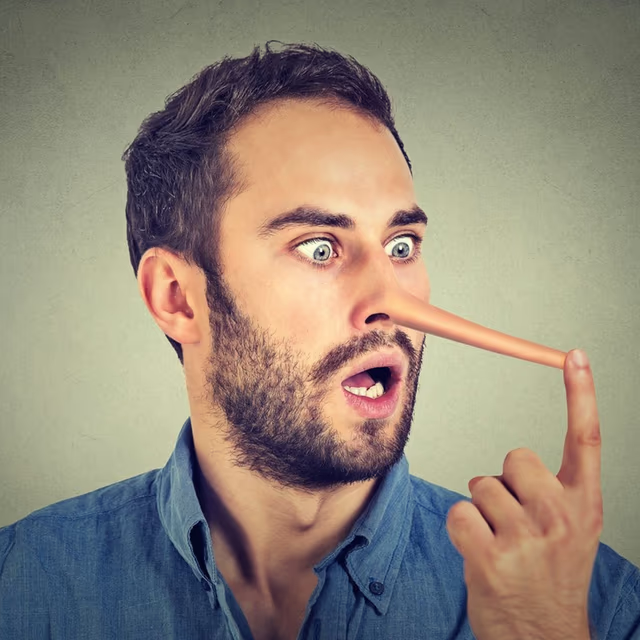
A folk observance on April 1 marked across many countries by hoaxes, pranks, and harmless deceptions played on friends, family, and the public.

Countdown to the day
--DAYS
--HRS
--MIN
--SEC
Last updated February 26, 2026 · by the Holiday Calendar TeamHave an update or spot an error?
YEARLY DATEApril 1
OBSERVED INInternationally
CATEGORYFun
SUBCATEGORYSilly
ORIGIN

Historical Origin

FOUNDING ENTITY
Not documented
FIRST OBSERVED
Not documented
The earliest clear reference is a 1561 Flemish poem. No founder or founding event is documented.
HOW THE HOLIDAY CAME TO BE

A day of fools with no known author.

The origin of April Fools' Day is genuinely undocumented and, in Britannica's words, effectively untraceable. No founder, founding act, or single establishing event is recorded. The earliest unambiguous reference is a 1561 Flemish poem by Eduard de Dene, an early attestation of the custom rather than its creation.

+ Know the story? Submit a founder Help us complete this holiday
INTRO

The most-told origin story is probably wrong

The story almost everyone repeats about April Fools' Day is that it began with a calendar. When Europe moved New Year's from spring to January, the tale goes, anyone who kept celebrating in late March became a "fool." It is tidy, it is everywhere, and folklorists think it is almost certainly untrue.

The problem is the dates. The custom is already on record in a 1561 poem, years before the calendar reforms that supposedly caused it. So the most famous "fact" about the day arrives a few years too late to be the cause.

That leaves a real mystery at the center of a silly holiday. Nobody knows who started April 1, or where, or why. The honest answer is the one almost no article gives you, and it is more interesting than the legend it replaces.

Advertisement

DEALS & OFFERS

2026’s deals have wrapped

See who celebrated this year, and browse offers from past years.

ORIGINS

April Fools’ Day history

INTRODUCTION

For a day this widely kept, April Fools' Day has a strikingly empty paper trail. Encyclopaedia Britannica calls its origins unknown and effectively untraceable. There is no founder to name and no first observance to date.

What survives is a handful of early sightings, each a little later than the last. The earliest clear one is a comic poem published in 1561 by the Flemish writer Eduard de Dene. In it, a nobleman keeps sending his servant out on pointless errands. The servant finally realizes the date is the joke: it is the first of April.

CHAPTER 01

The trail picks up in English

A century later the custom surfaces in English. In 1659 Francis Osborne described "the Dutch youth" playing tricks on "fools" at the start of April. In 1686 the antiquarian John Aubrey jotted down "Fooles holy day," noting "we observe it on ye first of April." Even then, the writers treated it as a foreign import they were only now recording.

CHAPTER 02

Nobody knew why, even in 1760

By the eighteenth century the day was settled in Britain, and people were already puzzled by it. An English almanac, Poor Robin's, captured the confusion in verse, admitting that nobody, including the people keeping the day, could say why they called it Fool's Day. The mystery, in other words, is not modern. It was baked in from the start.

CHAPTER 03

Why the calendar story keeps coming back

The popular calendar-change explanation fails on its own timeline: the de Dene poem predates the reforms it blames. Folklorists have a name for stories like it, a "migratory legend," a neat origin tale that gets attached to many holidays without evidence for any. The folklorist Alan Dundes put the scholarly verdict bluntly in 1988: more than a hundred years of study had added very little to what anyone actually knows. The day endures precisely because the joke needs no charter. It just needs April 1.

TIMELINE

Timeline

Earliest clear reference

Flemish writer Eduard de Dene publishes a poem about a servant sent on fool's errands on April 1, the first unambiguous record of the custom.

France moves New Year's Day

Charles IX's Edict of Roussillon sets the French new year to January 1, the event later blamed for the holiday despite postdating the de Dene poem.

First clear English account

Antiquarian John Aubrey records 'Fooles holy day,' observed 'on ye first of April,' the earliest plain English-language description.

The BBC spaghetti harvest

A Panorama broadcast shows a Swiss family pulling pasta from 'spaghetti trees,' the first televised April Fools' hoax.

Taco Bell buys the Liberty Bell

A newspaper hoax claiming the chain had purchased the Liberty Bell prompts an emergency National Park Service press conference.

The Left-Handed Whopper

Burger King advertises a burger redesigned for left-handed customers, and people line up to order one.
The First of April some do say / Is set apart for all Fool's Day / But why the people call it so / Nor I nor they themselves do know.
Poor Robin's AlmanacEnglish almanac, 1760

GOOD TO KNOW

April Fools' Day Around the World

France and Italy

The victim is a 'poisson d'avril,' or April fish: children try to pin a paper fish to an unsuspecting person's back.

Scotland

The day is 'Hunt the Gowk,' the gowk being the cuckoo and the fool, and the prank is sending people on errands with deceptive notes.

Scotland (April 2)

The fun spills into a second day, Tailie Day, when paper tails and 'kick me' signs are pinned to people's backs.

Ancient Rome

The spring festival Hilaria featured masking and role reversal; Britannica notes April Fools' somewhat resembles it, though no hard evidence links them.

MYTH VS FACT

Common Misconceptions

The myth

April Fools' Day began when a calendar reform left old New Year holdouts to be mocked as fools.

The truth

The custom is documented in 1561, before the calendar reforms that supposedly caused it, so folklorists treat the story as an unproven 'migratory legend.'

The myth

Chaucer referenced April Fools' Day in The Canterbury Tales around 1390.

The truth

The supposed April 1 line contradicts Chaucer's own placement of the tale in late spring, and scholars read it as a scribal error, not an April Fools' allusion.

The myth

The Roman emperor Constantine let a jester named Kugel rule for a day, starting the tradition.

The truth

That story was invented as an April Fools' prank by a Boston University professor in 1983 and reported as real before the Associated Press retracted it.

GOOD TO KNOW

Famous April Fools' hoaxes

The BBC's spaghetti harvest (1957)

Panorama showed a Swiss family pulling pasta from trees after a mild winter, and hundreds of viewers called the BBC to ask how to grow their own.

The Guardian's San Serriffe (1977)

A seven-page travel supplement profiled a tropical island nation whose every place name was a typographic pun.

NPR's Nixon comeback (1992)

A Talk of the Nation segment reported that Richard Nixon was running for president again, complete with a fake campaign slogan.

Taco Bell buys the Liberty Bell (1996)

Full-page ads in six newspapers claimed the chain had bought the bell to help the national debt, triggering a National Park Service press conference.

Burger King's Left-Handed Whopper (1998)

A USA Today ad described a burger for 32 million left-handed Americans, with the condiments rotated 180 degrees, and customers asked for both versions.

WHY THIS DAY MATTERS

Why We Love April Fools' Day

MEDIA

Even the BBC and NPR have pulled off April 1 hoaxes.

Respected institutions from the BBC to NPR have staged elaborate hoaxes on April 1, knowing the date gives them cover. No other day on the calendar lets a trusted broadcaster deceive its audience and be thanked for it.

FOLKLORE

It is a rare custom with no charter

Most observances trace to a founder, a law, or a campaign, and this one traces to none. It survives purely as inherited folk behavior, which is why scholars find it so hard to explain.

CULTURE

The same date, many local rituals

The day took on its own shape from country to country, from the French paper fish to Scotland's two-day run of errands and 'kick me' signs. That spread, without any central organizer, is part of what makes it durable.

GET INVOLVED

How to Celebrate April Fools' Day

EDITOR'S PICK

Pull a harmless, low-stakes prank

Keep it gentle and brief in the spirit of the original fool's errand. The point is a shared laugh, not real confusion or worry.

TRY

Try the French April fish

Cut out a paper fish and try to tape it to someone's back unnoticed, as French and Italian children do. It is the oldest surviving April 1 prank still in regular use.

READ

Read up on the great media hoaxes

Look up the BBC spaghetti harvest or the Taco Liberty Bell to see how far institutions have taken the joke. They are case studies in how a good hoax is built.

QUIZ

Quiz friends on the real origin

Ask people where the day came from and watch them repeat the calendar legend. Then share that no one actually knows.

READ

Read the day's history

Spend a few minutes with a folklore source such as the Library of Congress account of the holiday. It separates the documented record from the legends that have grown around it.

Test your knowledge

How well do you know April Fools’ Day?

1 / 8

What is the earliest clear reference to the April Fools' custom?

Answer

April Fools' Day falls on April 1 every year, and it is observed in many countries around the world.

FOR MARKETERS & CREATORS

Turn every day into a moment your audience actually shows up for.

8.4M
Monthly readers
5K+
Holidays tracked