Holiday Calendar

National Cocoa Day

Next celebratedSunday, December 13, 2026

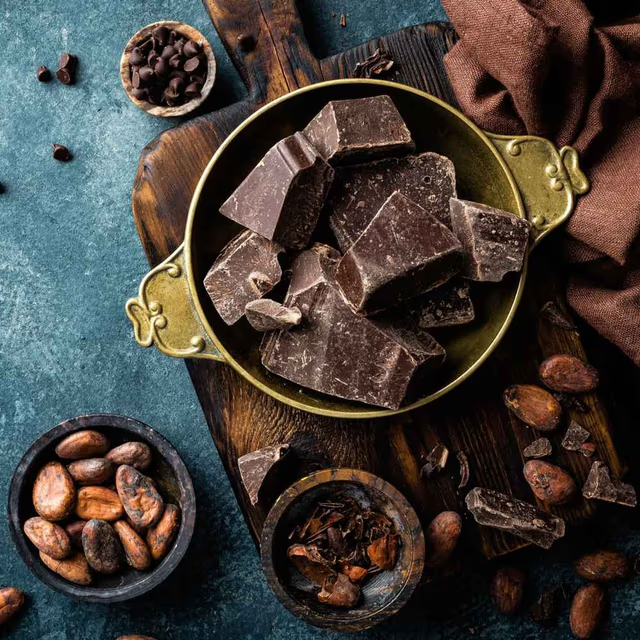
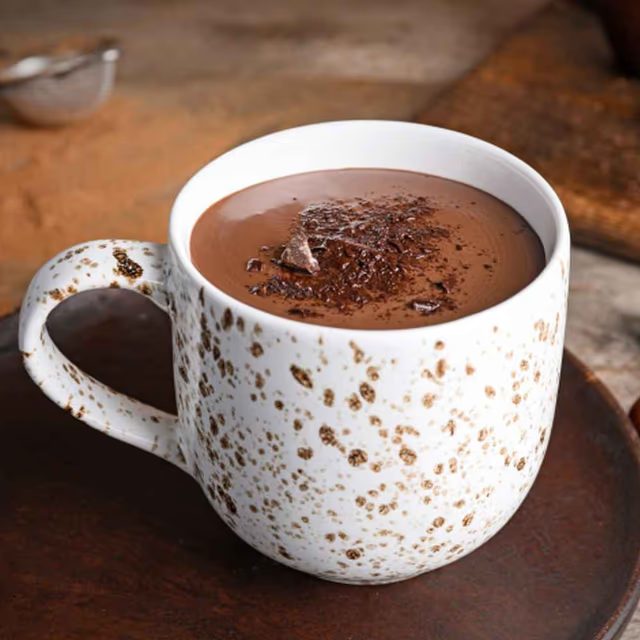
National Cocoa Day keeps December for the powder rather than the bar. Warm a mug of it slowly, or work a spoonful into a stew for the depth it brings to the pot.

Countdown to the day
--DAYS
--HRS
--MIN
--SEC
Have an update or spot an error?
YEARLY DATEDecember 13
OBSERVED INUnited States
CATEGORYFood
SUBCATEGORYChocolate
ORIGIN

Community Origin

FOUNDING ENTITY
Not documented
FIRST OBSERVED
Not documented
HOW THE HOLIDAY CAME TO BE

A December date kept for cocoa in its powdered form.

No founder, sponsoring organisation or establishing record for National Cocoa Day was identified. The Federal Register carries no document under the name, and the phrase appears in no edition of Chase's Calendar of Events digitised by HathiTrust.

+ Know the story? Submit a founder Help us complete this holiday
INTRO

A laboratory decides what your cocoa may be called

National Cocoa Day is named for a food that international law defines by what has been taken out of it. The Codex standard for cocoa powders sorts the stuff into three grades according to how much cocoa butter is still in it.

Then it declines to say how anyone should check. Under the heading for determining cocoa butter, the current text says only that the method is to be developed, and the entry for telling the three grades apart says the same. The moisture test, by contrast, is filled in.

The United States picked a method and stuck with it. Its rule sends a laboratory to a Soxhlet extraction set out in a chemists' handbook, and the number that comes back decides what the tin on your shelf is allowed to call itself.

Advertisement

DEALS & OFFERS

2026 ran without a deal

No tracked offers this year. Here’s who has celebrated in past years.

No tracked deals for 2026

National Cocoa Day ran on December 13 without a tracked deal. Browse past offers from previous years.

1 brand has run a deal
ORIGINS

Cocoa Day history

INTRODUCTION

Cocoa powder does not come off a tree. It is what is left once the fat has been squeezed out of ground cocoa, and the squeezing is the whole point.

Cocoa liquor is cocoa solids suspended in cocoa butter. Press it and two things come out, the butter and a cake that still holds between 10 and 24 percent fat. Break the cake, mill it, and you have the powder.

CHAPTER 01

Alkali, and the ceiling written into it

Somewhere in that chain a maker may reach for alkali. Cocoa nibs, or the beans before they are shelled, can be heated with carbonates or hydroxides, which lifts the pH toward 7 or 8.

The reasons are colour, taste, and how readily the powder will disperse in water. The step is optional, which is why two tins of the same legal food can look and taste quite different.

US regulators allow the treatment and then fence it. For each 100 parts by weight of nibs, the total alkali may not exceed the neutralizing value of 3 parts of anhydrous potassium carbonate. The permitted list is short and chemical: ammonium, potassium or sodium bicarbonate, carbonate or hydroxide, or magnesium carbonate or oxide.

CHAPTER 02

Where the three grades came from

On May 21, 1993, the Food and Drug Administration published its standards of identity for cacao products at 58 FR 29529. Three of its standards define grades of cocoa powder, and they are almost identical to each other.

The middle grade is written as the top grade all over again, with one clause changed. The lowest grade is the same trick a second time. Everything that separates the three is a fat figure.

National Cocoa Day arrives every December 13, and no founder, sponsor or establishing act for it turned up in the indexes searched. The day is kept for the tin, and the tin has rules.

TIMELINE

Timeline

A fat test gets final action

The Soxhlet extraction method for fat in cacao products received final action, the test the US cocoa rules still point to.

The shell test is published

The twelfth edition of the official methods carried the shell-in-cacao-nibs procedure that the cocoa standards still incorporate by reference.

Codex adopts a cocoa standard

The Codex Alimentarius Commission adopted a single standard covering cocoa powders and dry mixtures of cocoa and sugars.

Method 963.15 reaches print

The fat test the US cocoa rule relies on was carried in the analytical association's fifteenth edition.

FDA publishes the cocoa grades

The standards of identity for cacao products were published on May 21, giving breakfast cocoa, cocoa and lowfat cocoa their boundaries.

A technical amendment lands

The FDA issued an editorial amendment updating a standards body's name and address across twenty-three parts of its regulations.

WHY THIS DAY MATTERS

Why We Love National Cocoa Day

CHEMISTRY

Heavily alkalised cocoas averaged 3.9 mg of flavanols a gram.

A 2008 survey of commercial cocoa powders found natural, non-alkalised ones at an extractable pH of 5.3 to 5.8 and heavily treated ones at 7.61 and higher. Average total flavanol content ran from 34.6 mg per gram in the natural powders down to 3.9 in the heavily processed ones.

NAMING

The word chocolate is rationed by weight

Under the international standard, a mixture of cocoa powder and sugars may be called chocolate powder only if it is at least 32 percent cocoa powder by weight. The names on a tin are not marketing copy, they are what the composition decides.

RESEARCH

The trade is still tuning the recipe

A 2024 study ran its own alkalisation experiments across a range of sodium hydroxide concentrations, temperatures and times rather than surveying finished products. Concentration mattered more than temperature or time for the colour and pH markers that define the treatment.

BY THE NUMBERS

National Cocoa Day by the Numbers

22%
Cacao fat floor for breakfast cocoa
10%
Cacao fat floor for medium fat cocoa
20%
Cocoa butter floor, Codex top grade, dry basis
1.75%
Shell cap in cacao nibs, alkali free
7%
Moisture ceiling, Codex cocoa powder

GOOD TO KNOW

Surprising facts about National Cocoa Day

Cocoa can be treated with acid, not only alkali

Phosphoric acid, citric acid and L-tartaric acid are all permitted neutralizing agents for cacao nibs, and a powder made that way must carry the words Processed with neutralizing agent on its label.

The alkali statement follows the cocoa backwards

Processed with alkali must accompany the name of the food even when the alkali was used on the nibs the cocoa was later made from. Where the name is conspicuous on the label, the statement has to sit immediately before or after it with no printed or graphic matter in between.

Dutching can happen at three different points

Alkali can meet the cocoa as nibs, as press cake after the butter is out, or as liquor, and nib treatment is the most common. Two tins both reading processed with alkali may have met it at completely different stages.

One cocoa standard exists only for drink mixes

Cocoa with dioctyl sodium sulfosuccinate for manufacturing is a standardized food additive holding no more than 0.4 percent of that compound. It is permitted in dry beverage mixes as long as the compound stays at no more than 75 parts per million of the finished drink.

Two of the three cocoa grades answer to two names

Breakfast cocoa may also be sold as high fat cocoa, and the middle grade may be labelled either cocoa or medium fat cocoa. Only lowfat cocoa is given a single legal name.

GET INVOLVED

How to Celebrate National Cocoa Day

EDITOR'S PICK

Read the label before you open the tin

Look for the words processed with alkali, or processed with neutralizing agent, sitting right beside the name of the food. They are the only public signal of what happened to the cocoa before it reached you.

TASTE

Taste a natural cocoa against a Dutched one

Buy one of each and make the same drink twice, side by side. Alkali treatment changes colour and taste together, so the difference should show before you have tasted anything.

WHISK

Whisk the powder before you add the milk

Alkalisation exists partly to help cocoa solids disperse in water, so give it the chance. Work the powder into a little hot liquid first, then loosen it out to a full cup.

LOOK

Look up the grade your cocoa belongs to

The federal definition of cocoa runs to two short paragraphs and settles what the tin may be called. It is a two-minute read and it changes how the shelf looks.

COOK

Cook with the powder instead of a bar

Cocoa powder is the part that stays behind when the butter is pressed out, which is why it carries so much flavour for so little fat. Put a spoonful into a chilli, a braise or a loaf and see what it does.

Test your knowledge

How well do you know National Cocoa Day?

1 / 8

What decides which of the three US cocoa grades a powder belongs to?

Answer

No. It is an unofficial observance and a normal working day, and the Federal Register index holds no document under the name.

COLOPHON

Sources

How we know what’s on this page. References, not endorsements.

12sources
11primary records
12independently dated
Primary records
Office of the Federal Register2026
21 CFR 163.112, Breakfast cocoa
The US standard for the highest cocoa grade, its fat floor and its alkali labelling.
View source
Office of the Federal Register2026
21 CFR 163.113, Cocoa
The middle US grade, defined only by a narrower band of cacao fat.
View source
Office of the Federal Register2026
21 CFR 163.114, Lowfat cocoa
The lowest US cocoa grade and the fat level that defines it.
View source
Office of the Federal Register2026
21 CFR 163.110, Cacao nibs
Permitted alkalis and acids for cacao nibs, their quantity limits and the shell cap.
View source
Office of the Federal Register2026
21 CFR 163.5, Methods of analysis
The laboratory methods US cocoa rules incorporate for fat and for shell.
View source
Office of the Federal Register2026
21 CFR 163.117, Cocoa with dioctyl sodium sulfosuccinate for manufacturing
A standardized cocoa carrying dioctyl sodium sulfosuccinate, with its concentration limit.
View source
Office of the Federal Register2026
21 CFR 172.520, Cocoa with dioctyl sodium sulfosuccinate for manufacturing
Where that additive may be used and the parts-per-million ceiling in a finished drink.
View source
FAO and WHO, Codex Alimentarius Commission1981, amended 2025
Standard for cocoa powders (cocoas) and dry mixtures of cocoa and sugars, CXS 105-1981
The international cocoa powder grades, the moisture limit, and two methods still marked to be developed.
View source
Office of the Federal Register1998-03-24
Change of Name and Address; Technical Amendment
The 1998 FDA amendment updating an analytical association's details across twenty-three parts.
View source
Journal of Agricultural and Food Chemistry2008
Impact of alkalization on the antioxidant and flavanol content of commercial cocoa powders
A survey of shop-bought cocoas measuring pH against flavanol content across alkalisation grades.
View source
Food Research International2024
Influence of process conditions of alkalization on quality of cocoa powder
An experiment varying alkali strength, temperature and time to see what drives cocoa colour and pH.
View source
Additional coverage
FOR MARKETERS & CREATORS

Turn every day into a moment your audience actually shows up for.

8.4M
Monthly readers
5K+
Holidays tracked